
A SenArch Embodied Experiment
Taking SenArch Outside Wine: What Trained Attention Carries Into a New Medium
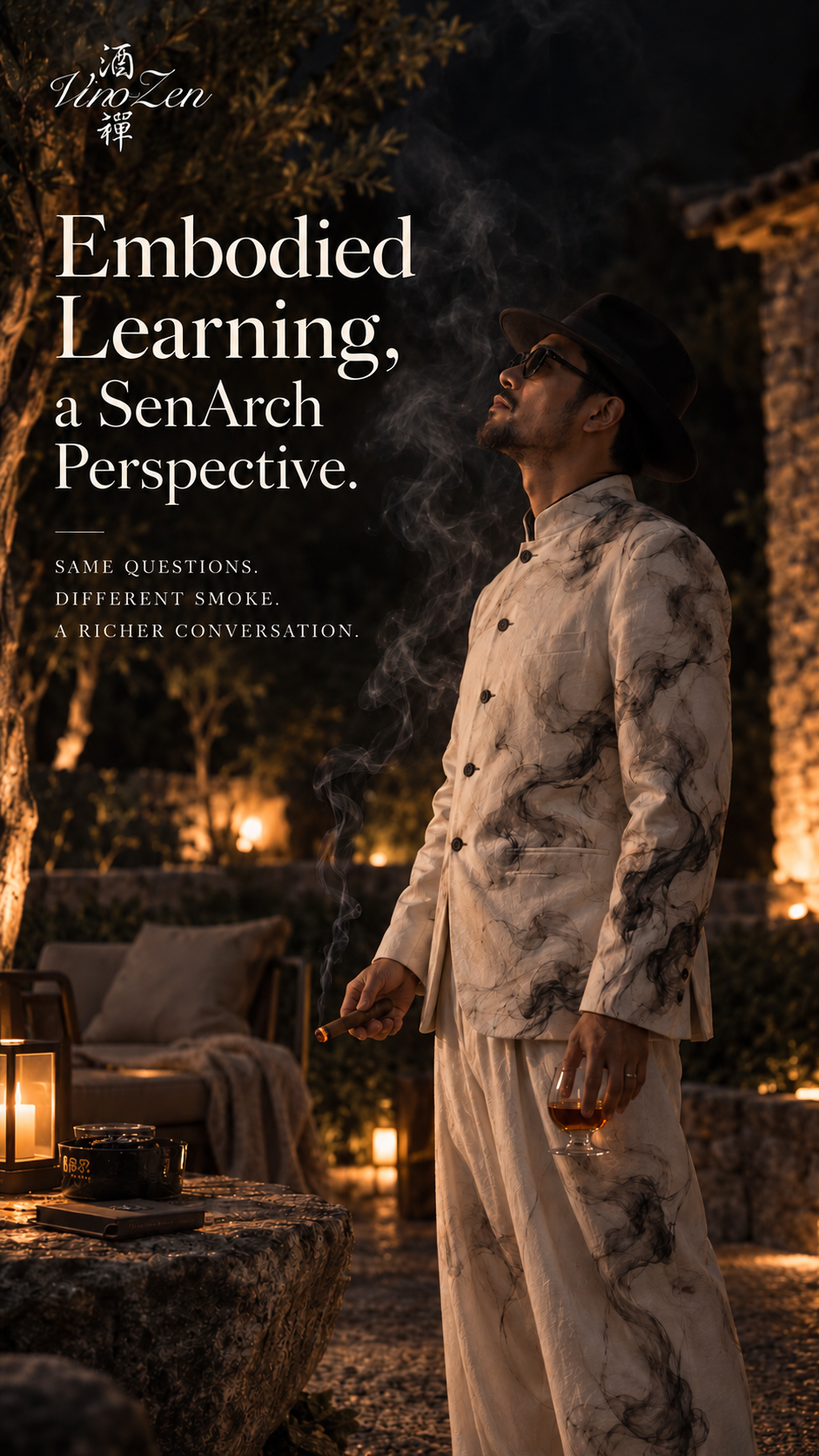
This article documents an adult sensory-learning experiment involving cigars and whisky. Tobacco is addictive and carries serious health risks, and alcohol also carries health risks. Neither is required to engage with SenArch. Within VinoZen, both are among the media I use to explore attention, context and pairing. The focus here is attentive experience.
SenArch came out of wine and spirits, which is also one of the problems with trying to evaluate it through them. I have spent years tasting, studying and teaching in this space. Before I pick up a glass, there is already a huge amount of structure sitting in my head: acidity, tannin, alcohol, climate, grape variety, oak, fermentation, distillation, maturation, production choices, regional expectations, stylistic references and all the bottles that came before. If SenArch helps me notice more in wine or spirits, it is difficult to separate what came from the framework from what came from experience.
So I wanted to take it somewhere I didn't have that advantage. I ended up with cigars, which I had been curious about for quite a while but had never actually taken the first step toward exploring. For most of my life, I have also been strongly against cigarette smoking, so there was already a mental barrier around smoking itself. One of the first things I learned about cigars was simple: DO NOT INHALE. That was probably the reason I was even open to trying one.
Call it retroactive justification if you like, but as a wine and spirits educator, if I am going to tell people an aged Cabernet has notes of cigar box and tobacco, as generations of educators before me have done, I should probably know what those things actually smell and taste like.
I also found the culture around cigars very different from what I had associated with cigarettes. The conversations I encountered were about construction, aroma, flavour, texture, pacing and how a cigar changed over an hour or more. Nicotine and health risks remain, but the culture was one of attention.
At the time of writing, I have only been seriously exploring cigars for about two or three weeks. I don't have years of tobacco knowledge, a developed cigar vocabulary or enough experience to know exactly what I should expect from a particular wrapper, region, blend or producer. I am still learning some fairly basic things as I go.
Calling myself a complete beginner still isn't quite right, though. I am a beginner with cigars. I am not a beginner at paying attention.
Years of wine and spirits have trained me to sit with something, compare sensations, notice development, separate intensity from quality, question what I think I am perceiving and leave something unresolved when I don't have enough information. I also know how I tend to learn things that involve smell, taste, texture and time.
That seems to have given me a head start. Years of sensory work had already built habits for entering something unfamiliar through attention, and I enjoy doing it enough to keep looking.
That also complicates the experiment. I wanted a medium where I did not already possess the expertise, and cigars give me that, but I did not arrive as a blank slate. I brought years of trained attention with me. There is also no alternate version of me smoking the same cigars without SenArch, or without my background in wine and spirits. Anyone who spends a few weeks paying close attention to something new should improve. I cannot assign every change in perception to the framework.
What I can document is how the learning develops.
SenArch has been built around Perception → Structure → Imagery → Meaning → Memory. Cigars give me a chance to see which parts of that sequence appear before I know the medium particularly well, where it becomes less convincing, and what the medium itself forces me to reconsider.
When I started, I was learning about wrapper, binder and filler, Cuban versus non-Cuban, and a few brands. Then the layers started multiplying. Volado, seco, viso and ligero. Primings. Tobacco genetics. Seed versus growing region. Corojo and Criollo. Fermentation and aging. Vitola. Construction. Draw. Combustion. Ring gauge changes the relationship between wrapper and filler. The shape of the cigar changes how it develops. Storage and humidity change how it behaves before I even light it.
A lot of that knowledge arrived after I had already started noticing things.
I would smell something grassy, heavily fermented, almost seaweed-like, earthy, roasted or unusually clean, then start looking for what might be behind it. Sometimes I found a plausible explanation. Sometimes there were several possibilities. Sometimes the information simply wasn't available.
I like learning in that order.
Most appreciation education tends to give you structure first. Learn the region, terminology, production method and classifications, then go experience the product with that structure already sitting in your head.
With cigars I have been doing quite a bit of the reverse. Notice something, become curious about it, learn enough to investigate it, then come back with slightly better resolution. The next cigar gives me something else to chase.
Knowledge still matters. Curiosity simply does not have to wait until someone has learned enough vocabulary to justify having an observation. You still have to notice enough to become curious in the first place. For me, keeping an open mind starts there: noticing before deciding what something is supposed to be.
At first, cigar tasting also looked much more flavour-driven to me than it does now. Coffee, chocolate, leather, cedar, pepper, nuts, earth. After a few cigars, those descriptors stopped being enough. Two cigars can share most of the same flavour notes and still be completely different experiences. I have run into the same problem in wine and spirits, where a tasting note can be accurate and still tell you surprisingly little about the experience.
Smoke density is not flavour intensity. Nicotine strength is something else again. Aroma can be lifted or subdued. Texture can change even when the flavour list doesn't. Some flavours feel compressed together while others have space around them. A cigar can give me fewer identifiable notes but much more definition between them.
The Rocky Patel Sun Grown Maduro Robusto was one of the cigars that made me notice this. I was getting tobacco, spice, nuts, leather, coffee, cocoa and a slight salinity underneath. What stayed with me more than the list was the separation. Each part seemed to have room around it.
It also burned exceptionally well.
That became more important after smoking other cigars that needed repeated relights. I stopped treating construction as a technical score sitting beside flavour. If a cigar keeps going out, I relight it. It cools, then heats again. My pace changes. I may start drawing harder because I am trying to keep it alive. Combustion changes and whatever progression was happening gets interrupted.
The construction has already entered the tasting.
The Crowned Heads Tennessee Waltz gave me almost the opposite experience. It opened mildly with sweetness, black pepper, cedar, warmth and something I kept describing as peanut shell. In the second third it became creamier and unexpectedly floral. Then the relights started. By the final third, much of what had made the earlier part interesting had narrowed into spice.
I can't cleanly separate that experience into tobacco, blend, construction and my own technique. They all happened together in the cigar I actually tried.
Cigars make that interaction much harder to ignore than wine does. With wine I can change temperature, glassware, aeration, food, pacing, music and environment, but the liquid itself is fundamentally already made. Whisky is even more stable. I can add water or use another glass, but I am mostly receiving and interpreting something.
A cigar makes me participate in producing the thing I am tasting.
I cut it. I light it. I decide how I toast the foot. My draw affects airflow. Puff frequency affects temperature. I can overheat it or let it cool. Humidity changes combustion and aroma delivery. Retrohaling changes what becomes available to me. Even where I am along the cigar changes what is burning and in what proportions.
The Rocky Patel A.L.R. Second Edition made that even clearer. The first part of the cigar was very much in my lane: smooth, aromatic, lots of smoke, cocoa, coffee, some salinity, white pepper and a long finish. As it moved along, spice, cocoa and coffee intensified and wood and charcoal began to appear. By the final third, earth, wood and spice had taken over enough that I stopped enjoying it, so not long into that final third I let it go out.
Normally I might simply write that down as the way the cigar developed.
Except I had also spent part of the smoke trying to practise blowing smoke rings. Yep.
That meant I was drawing differently, holding smoke differently and probably changing my usual cadence without really thinking about it. I cannot say that caused the later change in the cigar. I did not control for it, and I am not going to rewrite the experience afterward because one explanation happens to sound plausible.
I'm not just observing the cigar. I'm operating it.
It feels more like a conversation with the object than wine or spirits usually do. I act, the cigar changes, I notice the result, then I adjust again. With wine and spirits, attention mostly changes what I notice. With a cigar, attention can also change what happens next.
The next puff is partly the result of what I just did. That feedback loop is much more immediate than anything I normally encounter with wine or spirits.
That brought me back to something very familiar from wine and spirits: scores and ratings. The Rocky Patel A.L.R. Second Edition Toro received 96 points and ranked No. 4 on Cigar Aficionado's 2023 list. My experience landed nowhere near that. Some of that may have been my own doing. In a medium where my cadence, technique and the cigar's physical condition can all affect what happens over the next hour, the distance between someone else's score and my own experience becomes especially interesting.
That also makes cigars a strangely intentional vice. A glass of whisky will sit there quite patiently while I ignore it. A cigar can punish me for getting enthusiastic.
The Davidoff Winston Churchill The Original Series Robusto showed me another side of SenArch. The flavour profile was relatively restrained and not especially layered. I remember how composed it felt: calm, steady, everything somehow in the right place. The whole thing became a quiet evening where everything slowly settles down.
That image has survived better than the tasting notes.
I could reconstruct the flavours if I wanted to, but that isn't really how the cigar exists in my memory anymore. The sensory impression had moved into structure, then imagery, then personal meaning, and that is what remained in memory. Of everything I have smoked so far, this is the clearest example of the complete SenArch sequence appearing with cigars.
It is also only one example.
Most of the other cigars have given me much stronger evidence for Perception and Structure than for Imagery, Meaning and Memory. That could be because I haven't spent enough time with them. It could be that not every experience naturally develops through the entire sequence. The later stages may also be less universal than I assumed when I originally built SenArch.
I have to be as suspicious of the sequence as I am of everything else in the framework. I built it, so I am perfectly capable of seeing it because I expect it to be there.
With the Oliva Serie V Double Robusto, I started getting a fragment of imagery around the second third: a prairie with gentle wind, carried partly by the sidestream smoke. But I was also sitting outside on a balcony, so I can't pretend the image belonged to the cigar alone. It may have come from the cigar, the air, the setting and my own attention together.
The Davidoff Grand Cru No. 2 went in another direction. It was very fragrant and clean, with spice, cream, nuts, light cocoa and coffee, cedar and a little fruit. Later it picked up more traditional tobacco character, more smoke and more weight. The retrohale was much stronger than I expected from something that initially felt so elegant.
It was less steady than the Winston Churchill, and I found it more interesting because of that.
That started separating a few words I had probably been compressing together. Better, interesting and complex do not automatically describe the same quality. Something can be beautifully composed without moving very much. Another cigar can be less composed but change more dramatically. Complexity may describe something else entirely.
Tasting language flattens a lot of different experiences into a fairly small vocabulary.
I also tried something else with the Grand Cru. While smoking it with whisky, I played some of the music I had created through SenArch. I wasn't running a formal test. I just wanted to see how the experience felt together.
It became richer and more enjoyable.
I didn't track exactly what changed.
I wasn't sitting there writing down whether the cigar became heavier, whether the aroma seemed more lifted, whether the texture changed or whether certain flavours became more obvious. I was too immersed in it. At some point I had stopped dissecting the experience and was simply inside it.
So I can't turn that evening into evidence of a specific cross-modal effect. I don't know exactly what the music changed. I only know that the experience was noticeably different and that I enjoyed it more.
SenArch began partly as a way of paying closer attention, but that experience also reminded me that deeper attention does not necessarily mean more analysis. Sometimes the framework may help create the conditions for immersion and then disappear from the foreground. I am leaving that observation where it is rather than building another theory around it.
With wine and spirits I have been working with Lift, Mass, Grip, Flow and BPM as perceptual variables that can eventually be translated into music. Cigars are already suggesting some possible parallels. Aroma can have Lift. Smoke density and physical weight may connect to Mass. Spice, pressure and persistence may have something to do with Grip. The way a cigar develops clearly has Flow.
BPM becomes particularly interesting because of that feedback loop. My own pace can physically change the cigar. In this medium, the tempo of the perceiver can become part of the stimulus.
I don't want to copy the existing variables directly onto cigars because the analogy happens to work nicely. If every new medium conveniently fits the model I already built, I am probably just finding what I taught myself to find.
Cigars may need dimensions that wine does not. Combustion is already hard to ignore. Smoke volume may deserve to stand on its own. Temporal development is more physical because the object itself is changing shape and disappearing while I experience it.
I would rather let cigars put pressure on SenArch than use SenArch to tidy them into familiar boxes.
My own preferences have started becoming visible surprisingly quickly too. Repeated relights bother me. A diesel-like finish can wipe out whatever interest I had before it. I seem drawn toward weight, cocoa, coffee, nuts, leather, some salinity and a longer finish, with enough substance to feel grounded without simply becoming harsh. Stable combustion makes a large difference, although complete consistency is not necessarily what I want either. Some movement keeps me interested.
The A.L.R. added another qualification to that. A cigar can begin very strongly for me and then lose me completely in the final third. The first half does not disappear because the ending went wrong, but neither do I feel obliged to finish something simply because it started well.
At the same time, learning more introduces another problem. I now know more about brand reputation, pricing, prestigious releases, tobacco origins and the characteristics commonly associated with different wrappers and blends. That information can improve understanding, but it can also leak backward into perception.
Wine does this constantly. Mention graphite in a Cabernet before people taste it and pencils begin appearing around the room.
So I've been trying to keep the process simple. Smell the wrapper and foot. Take the cold draw. Smoke it. Pay attention. Write down what is actually happening. Research afterward.
Cigars are useful training for this because plenty of information simply isn't available. Exact primings may not be disclosed. Blend descriptions can be vague. Fermentation details may be proprietary. Aging statements don't always tell you very much. There are plenty of opportunities to invent a technically plausible explanation after the fact.
I'd rather leave a blank.
SenArch becomes much less useful to me if it turns into a sophisticated way of telling stories about things I cannot actually know.
The ritual around cigars has also become more interesting as I spend more time with them. Cutters, punches, soft flames, jet flames, toasting, ashtrays, rests, humidors, humidity, temperature, travel cases. From outside, some of it looks ridiculous. Some of it probably is.
Wine and spirits have rituals too, but comparatively those rituals do much less to alter the product once I am actually consuming it. Glassware, temperature, aeration, dilution, food and pacing can all change perception, but the wine or whisky is still largely sitting there waiting for me. The ritual mostly shapes how I approach it.
With cigars, the ritual reaches further into the experience itself. The cut changes the draw, the light establishes the burn, and even how long I leave the cigar alone can change what comes next.
So the ritual is not only creating attention. It is partly creating the experience.
A cigar does not cooperate particularly well with being rushed. I have to sit somewhere, manage it, watch the burn and allow it to develop. For the next hour, sometimes longer, some part of my attention stays attached to this object. Even when I am talking to somebody or listening to music, the cigar keeps asking for small adjustments.
The cigar community seems connected to that too. My sample size is tiny, but I have found people surprisingly comfortable with visible beginner status. Someone shows you how they cut something. Someone explains why they prefer a punch. Cigars get passed around. People admit they haven't tried something or simply don't know.
That environment fits the way I have been learning.
“I don't know, but I noticed this” is allowed to be a complete sentence.
Wine could use more of that.
This is also why I want to write about the experiment now instead of waiting until I understand cigars much better. If I come back to this after a year, I will probably know far more about tobacco, construction, regions, producers and technique, but I will have lost some access to the beginner stage. I won't remember as clearly which sensations appeared before I had the vocabulary and which became visible only after I learned what I was supposedly looking for.
The first few weeks have already shown me something I had not fully appreciated before. Years of learning wine and spirits gave me more than information about wine and spirits. They trained a way of paying attention, and taught me how many things there are to notice.
I came into cigars knowing very little about tobacco, construction, origins or technique, but I did not come in without a way to learn. I already knew how to slow down, notice change, compare experiences, sit with uncertainty and allow an impression to exist before I had the vocabulary to explain it. That seems to have allowed me to appreciate a completely unfamiliar medium much more deeply, and much sooner, than I expected.
I cannot separate how much of that comes specifically from SenArch, how much comes from years of tasting, and how much comes simply from concentrated curiosity. I don't think I need to yet. The transferable part may be less the knowledge itself than the practice of attention that was built through it.
So far, Perception → Structure has appeared repeatedly. Imagery → Meaning → Memory has appeared much less often, with the Winston Churchill being the clearest example. Lift, Mass, Grip, Flow and BPM offer some interesting possibilities, but I don't yet know which of those will survive once cigars have had more time to push back.
The Grand Cru showed me that music can enrich the experience even when I stop tracking exactly what is changing. The Tennessee Waltz showed me how construction can interrupt sensory development. The A.L.R. showed me that my own behaviour can become part of the physical evolution of what I am tasting.
None of that proves that SenArch transfers perfectly into cigars.
What it does suggest is that trained attention transfers.
I can enter something new without beginning entirely from zero.
That, for now, is conclusion enough.
Not what something is. What it becomes when experienced.