
The Sale That Almost Happened
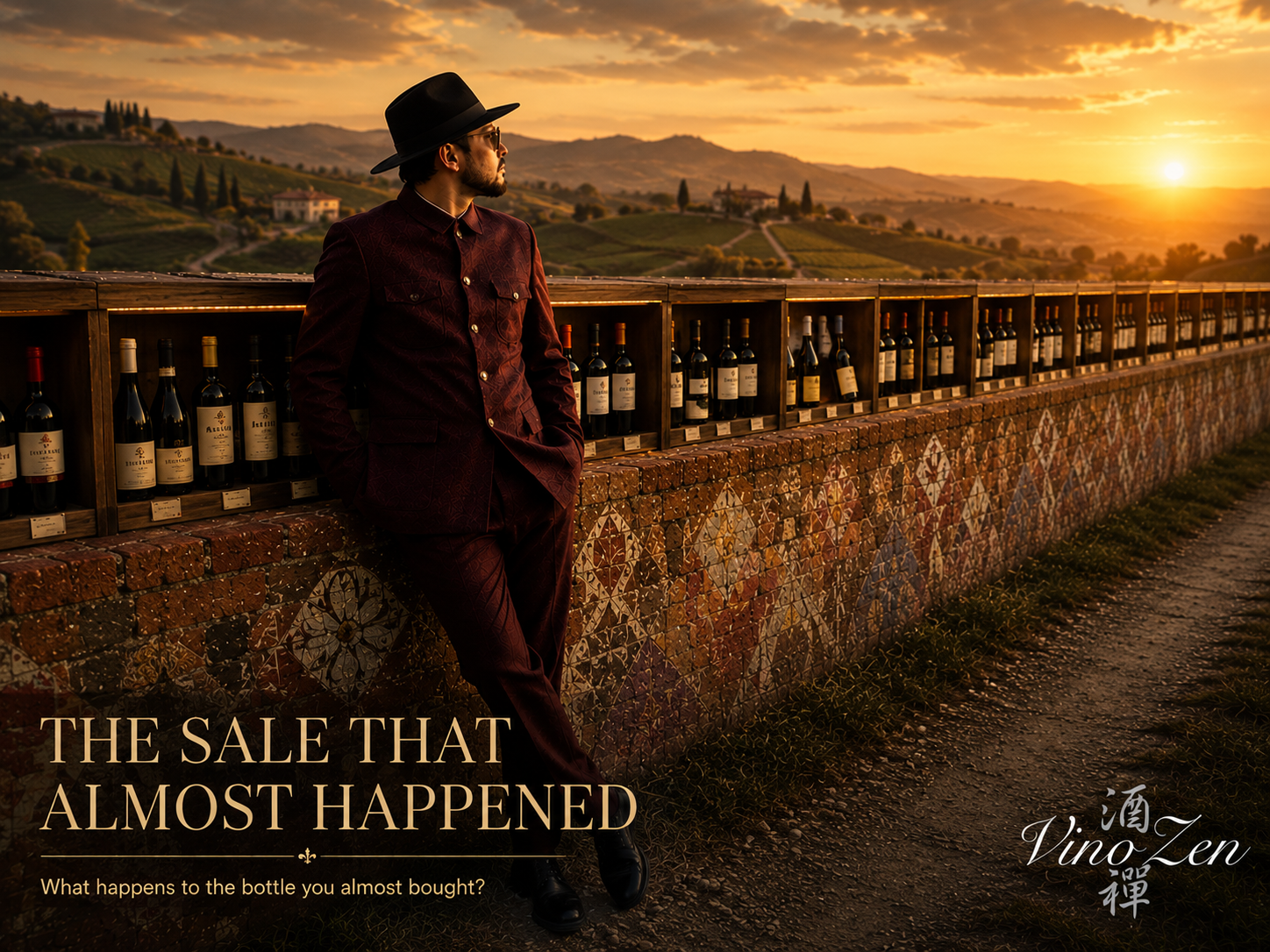
I spent about half an hour browsing in a liquor store recently and left without buying anything.
That sounds ordinary enough. What was more interesting was how much I almost bought.
I had gone in already thinking about replacing a bottle I was running low on, around $40. Then I found myself looking at Okanagan Pinots, Napa Cabs, Brunellos, Rieslings, whisky, gin, a couple of Australian wines I had wanted to try for a while, and one particularly interesting bottle from Clos Cibonne, a Côtes de Provence Cru Classé estate, made largely from Tibouren.
That one stopped me.
I didn't really know what to make of the Cru Classé designation. Apparently that wasn't the part of my DipWSET studies that permanently lodged itself in my brain.
I picked the bottle up more than once, trying to read the colour through the tinted glass and figure out exactly what I was looking at.
And, somewhat hilariously, my phone had no signal in the store.
So I couldn't even do what most of us now instinctively do when curiosity outruns our knowledge: look it up.
The store wasn't busy at all. There were staff around, including two people standing at the cash with no line.
Nobody came over.
Would someone working there necessarily have known the history of Provence's Cru Classé classification or been able to give an encyclopedic answer about Tibouren?
Maybe not.
That isn't really the point.
“I don't know much about that one either, but let me find out.”
That would have been enough.
I looked it up after returning to civilization, where there was Wi-Fi, and understood what I had been staring at. Tibouren. Copper-toned. Savoury and saline. A little nutty. A style of rosé with considerably more going on than the pale, poolside Provence stereotype I had in my head.
Exactly the sort of thing I could imagine drinking on a hot summer day and still putting beside grilled food or smoky BBQ.
That was what I had been standing there trying to discover.
Would I have bought it if someone had told me that in the store?
Depending on the delivery, and whether some genuine curiosity or passion came through, I probably would have bought it just to satisfy mine.
Realistically, I was never going to buy everything I looked at that day. But there was probably $200 to $300 of genuine consideration happening across several categories.
I bought nothing.
Not because the service was offensive. There wasn't really enough of an interaction for it to be. Not because I couldn't choose something myself.
Nothing moved the consideration forward.
And that got me thinking about what a retailer actually sees.
Transactions. Average basket. Category mix. Margin. Inventory turns.
But what does the system know about the customer who almost bought?
It doesn't know which bottles I picked up, which ones I returned to, where I hesitated, what I was trying to understand, or how much possible spending quietly became zero.
Then I started noticing similar moments with other customers.
I should probably clarify something here: I don't work at these stores.
It may just be an occupational hazard, but when someone is standing in front of a wall of wine or spirits clearly trying to solve something, I tend to notice.
Apparently I have a hard time leaving these things alone.
One man was looking at Scotch for his grandfather's 80th birthday. How did I find out? By asking questions, of course.
The obvious answer might have been to point him towards a nicer Scotch, but without knowing more, do we go Lowland, Speyside or smoke him with Islay?
But after talking for maybe a minute, I learned that his grandfather normally drank regular Wiser's - ok so not Islay.
“Let me show you something,” I said.
I took him to Wiser's Red Letter, locked in a glass cabinet.
“It tastes a bit like a cowboy stomp-dancing,” I told him. “Homey, with some power and a rugged richness.”
More importantly, it was familiar enough to connect with something his grandfather already enjoyed, but special enough to mark an 80th birthday.
“If you really want to go for it, you should also consider the 24-year-old Wiser's. I said before leaving them to it.
Out of the corner of my eye a few minutes later, I saw them ask a staff member to open the cabinet.
I didn't wait around to see whether they actually took it to the cashier, but I moved the consideration forward within minutes.
Another customer came in looking specifically for Barbera d'Alba. Someone correctly showed her where it was.
Nothing wrong with that.
What caught my attention was that she went straight to it. I honestly can't remember the last time I saw someone make a B-Line for Barbera d'Alba in a general liquor store, other than me, and usually because I need it for a class.
So naturally, I got curious.
When I happened to talk with her afterwards, I discovered that she had chosen Barbera d'Alba because she had asked AI what wine she should buy for someone she respects.
Barbera d'Alba is certainly beautiful and well made, and I've enjoyed it on multiple occasions, but it still wouldn't be my first choice as a gift for that purpose.
She hadn't arrived at it through some long-standing love of Barbera. It was simply the answer she had been given.
They weren't wine drinkers themselves. They were buying for someone who was, which is particularly tough.
What they could evaluate with confidence had less to do with the quality of the wine itself and more to do with what was on the label, what the bottle communicated, and whether it stayed within budget.
There was more that went on in that conversation, but I digress.
These interactions further reinforced something I keep wishing there were more of in liquor retail: personal touch.
Not because humans know everything.
They don't.
Sometimes the missing piece isn't information. It's the human ability to notice context, respond to it, and keep adjusting as the conversation unfolds.
She had used AI because she needed help deciding what to buy.
I wanted to use AI because I needed help understanding the bottle in front of me.
She had an answer from a machine before entering the store.
I couldn't get one because there was no signal.
Yet both situations still came back to a conversation between people in the room.
Sometimes the value isn’t having the answer ready. It’s noticing that there is a question.
Of course, I also had an advantage the staff didn't.
I had no checkout to watch. No task list. No stock to put away. No concern about whether I was spending too long with one person. And I didn't have to worry about whether approaching someone would come across as pushy.
Which is precisely why I don't think the answer is simply telling people to engage more.
The harder question is knowing which moments are worth entering, and how much of yourself to bring into them.
There is some interesting research behind that.
Cron and colleagues looked at retail salespeople disengaging from customers they judged unlikely to purchase. When traffic was high and there were other prospects competing for attention, disengaging could make economic sense. Under low traffic, that logic became much weaker.
That becomes particularly interesting when two people are standing at an empty checkout while a customer keeps returning to the same unfamiliar bottle.
Jain, Misra and Rudi came at the problem from another direction, using in-store video linked to purchase behaviour. Sales assistance affected purchase decisions, but its benefit diminished as the amount of assistance increased.
Which is important.
The lesson isn't that customers need more and more attention.
If anything, the first useful interaction may be worth considerably more than the fifth.
And in my case, there wasn't even a first.
Not every browser needs help. Some know exactly what they want. Some genuinely want to be left alone. Good hospitality has to recognize that too.
But sometimes someone picks up the same bottle twice, compares a few products, then comes back.
Those aren't guarantees of a sale.
They're moments of consideration.
And perhaps the opening doesn't have to be:
“Do you need help?”
Maybe it is simply:
“Can I tell you what's interesting about that bottle?”
Now you've contributed something before asking the customer to explain themselves.
Maybe they want to know more or tell you what they're cooking. Maybe they just liked the label. Maybe they politely go back to browsing.
All of those responses tell you something.
Because good hospitality isn't about maximizing customer interactions.
It's about recognizing when an interaction might actually add value.
And sometimes that value extends beyond the bottle being considered right now.
The right conversation might turn an abandoned decision into a purchase. The right recommendation might help someone choose something that genuinely fits.
But sometimes it creates something harder to see on a sales report.
Trust.
Once someone knows there is a person in that store who listens, doesn't automatically push the expensive option, and can turn a vague thought into something that makes sense, the next decision becomes easier.
Maybe they come back. Maybe they ask before defaulting to the safe choice. Maybe they're willing to explore something unfamiliar because someone has earned the right to guide them.
And that brings me back to the thing retail data can't really show.
Point-of-sale data can tell us what people bought.
It cannot tell us what they almost bought, why they hesitated, or what might have happened if someone had noticed at the right moment.
That's part of what I'm trying to build through SenFlow: helping people recognize customer consideration, understand when they can genuinely add value, and adapt the interaction to the person standing in front of them.
Not more scripts.
Not more product facts.
Something much closer to judgment.
Because the sale that almost happened is invisible.
The moment that created it doesn’t have to be.
And maybe that’s how we build more wine and spirits lovers in the first place.
---
- Cron, W. L., Alavi, S., Habel, J., et al. (2021), [“No conversion, no conversation: consequences of retail salespeople disengaging from unpromising prospects”](https://doi.org/10.1007/s11747-020-00763-x), Journal of the Academy of Marketing Science, 49, 502–520
- Jain, A., Misra, S., & Rudi, N. (2020), [“The Effect of Sales Assistance on Purchase Decisions: An Analysis Using Retail Video Data”](https://doi.org/10.1007/s11129-020-09223-w), Quantitative Marketing and Economics, 18, 273–303