
VinoZen SenArch Selection 2026
Overview
Released August 30th, 2026
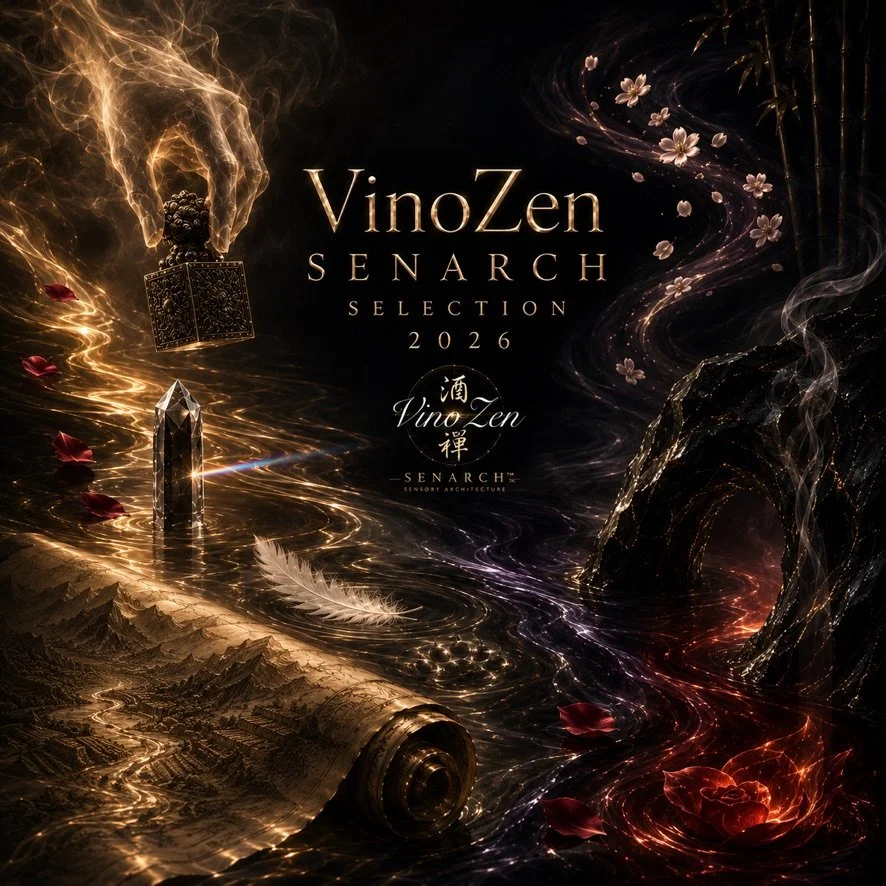
VinoZen SenArch Selection 2026 is a collection of 12 sensory translations built from four white wines, four red wines, and four spirits. Rather than ranking bottles by score, price, or prestige, the Selection focuses on the encounters I have had over the past year that generated the strongest perceptual worlds.
Each piece begins with what happened in the glass, then follows that perception into structure, movement, imagery, sound, and meaning. Acidity becomes light and direction. Tannin becomes resistance and architecture. Texture becomes material. Warmth becomes expansion. A finish can become distance, memory, or lingering resonance.
Sometimes, though, the whole picture arrives first, completely unexpectedly and instinctively. I then have to go back into the individual elements and figure out why it appeared in the first place. That is part of the fun of the creative process for me.
The album was created through a mixture of technical analysis and instinctive metaphorical revelation. Each impression was experienced, examined, challenged, revisited, revised, and experienced again before taking its final form in the album.
From the crystalline precision of Erratic and the hidden kinetic energy of Attack, to the geological weight of Balasto, the flourishing abundance of A Life From Apalta, and the quiet, lingering resonance of 響きの余韻 (Hibiki no Yoin), the 2026 Selection documents SenArch as it has evolved from experimental wine-and-music pairing into a broader form of sensory translation.
At its core, we ask:
When we look past what something is, what can it become when experienced?
If you get a chance to taste any of the wines or spirits that inspired the album, I would genuinely love for you to try them first without the corresponding track, then again with the music playing. I find the experience comes through best at a good listening volume, with enough bass presence to let the full structure of the track emerge.
Before you begin:
Take a deep breath.
Calm your senses.
Let them sit somewhere between serenity and intent.
Then listen.
Does anything seem to shift?
Does something become more prominent?
Does your experience move in a completely different direction from mine?
That, to me, is where this becomes most interesting.
HYPERFOLLOW PAGE:Links to major streaming platforms and social media
VinoZen SenArch Selection 2026
For most of my life with wine and spirits, tasting began with language.
Fruit. Flowers. Herbs. Oak. Acidity. Tannin. Texture. Finish.
That language was essential as a foundation. It gives us a shared way to analyze and communicate what is in the glass.
But one can only take so much of the same thing.
There is so much more in each glass than the structures we normally use to describe it. During much of my own learning process, there was a constant tension between saying what was academically accepted and articulating what I actually felt.
The interesting thing is that the two are not really in opposition. They can sharpen one another. Technical analysis can refine instinct, while instinct can reveal something that analysis alone may not capture. It is less about one being right and the other wrong, and more about learning how they inform each other, something formal education does not always make obvious at the beginning.
A great deal of formal wine and spirits education focuses on everything that happens before the liquid reaches the glass in front of us: climate, terroir, raw materials, production, winemaking, maturation, ageing, and the ways those factors shape style.
Even tasting itself is often used to validate that knowledge. We identify acidity, tannin, aroma, texture and flavour, then trace them back to climate, place, production choices and development.
It is a deeply established model of professional training, refined over half a century, and it has become the dominant mainstream language for understanding and discussing wine and spirits. In many circles, it can even feel like the only fully legitimate one.
But comparatively little attention is spent on what happens after we perceive those things.
If wine and spirits are really about enjoyment and appreciation, and I would genuinely love for someone to tell me if they aren't, and explain why, then:
What does that actually look like?
Surely it has to involve more than knowledge, analytical accuracy, or demonstrating tasting skill.
If education ultimately exists to deepen appreciation, then ideally we should leave wanting to return to the glass with greater curiosity, not feeling relieved to burn the flash cards, reach for a beer, or avoid wine and spirits for the next few weeks. Not everyone wants to become a professional, nor should they need to in order to enjoy wine and spirits.
So now I have to ask:
What happens after the tasting note?
What happens when acidity stops feeling like a number and starts feeling like movement?
When texture suggests material?
When a finish creates distance, space, time or tension?
When a wine leaves behind an image that sounds completely absurd when described literally, yet somehow feels precise when you return to the glass? And yes, there are quite a few of those in this album.
That question eventually became SenArch, the result of more than a decade of experimenting with how I experience, understand and communicate wine and spirits.
After the VinoZen Society Selection 2024, which explored Okanagan Pinot Noir, and the VinoZen Society Selection 2025, which turned to Canadian whisky, this somehow feels like the natural progression. The 2025 Selection was already moving in this direction: the bottles that made the cut were those that delivered both technical quality and a sufficiently distinctive experience to generate vivid metaphors.
The VinoZen SenArch Selection 2026 brings together twelve original works:
4 whites.
4 reds.
4 spirits.
They are not necessarily the most expensive bottles I tasted this year.
They are not the highest-scoring.
And this is not a “Best of 2026” list in the traditional sense.
They are here because each one opened a door.
Each gave me something beyond descriptors.
A structure.
A movement.
An atmosphere.
Sometimes an image.
Sometimes a place.
Sometimes an entire world.
And eventually, those impressions became sound, imagery, movement and memory.
And I will remember them for years to come.
VinoZen SenArch Selection 2026
WHITE RESONANCES
01 — THE LUMINOUS DEEP
Blue Mountain Vineyard & Cellars, Blossom Slope Block 17 Chardonnay 2022
Okanagan Falls, British Columbia, Canada
13% ABV
Initial Impression
This is the unusual one.
The Luminous Deep existed before the wine.
It was one of the earliest pieces I created for SenArch, originally built around the sensory architecture of white wines with beautifully integrated oak.
Then, during the first SenArch Pilot, I tasted Blue Mountain's Block 17 Blossom Slope Chardonnay 2022, and suddenly the two fit.
The wine showed floral lift, citrus, ripe apple and refreshing acidity, but what interested me more was the balance between:
texture, tension, pacing and gradual unfolding.
The oak was there, but it never became the subject.
There was depth without heaviness, and enough freshness to keep the whole thing lifted.
Inspiration
The music already had that same contrast.
Light above.
Depth underneath.
That became the visual idea.
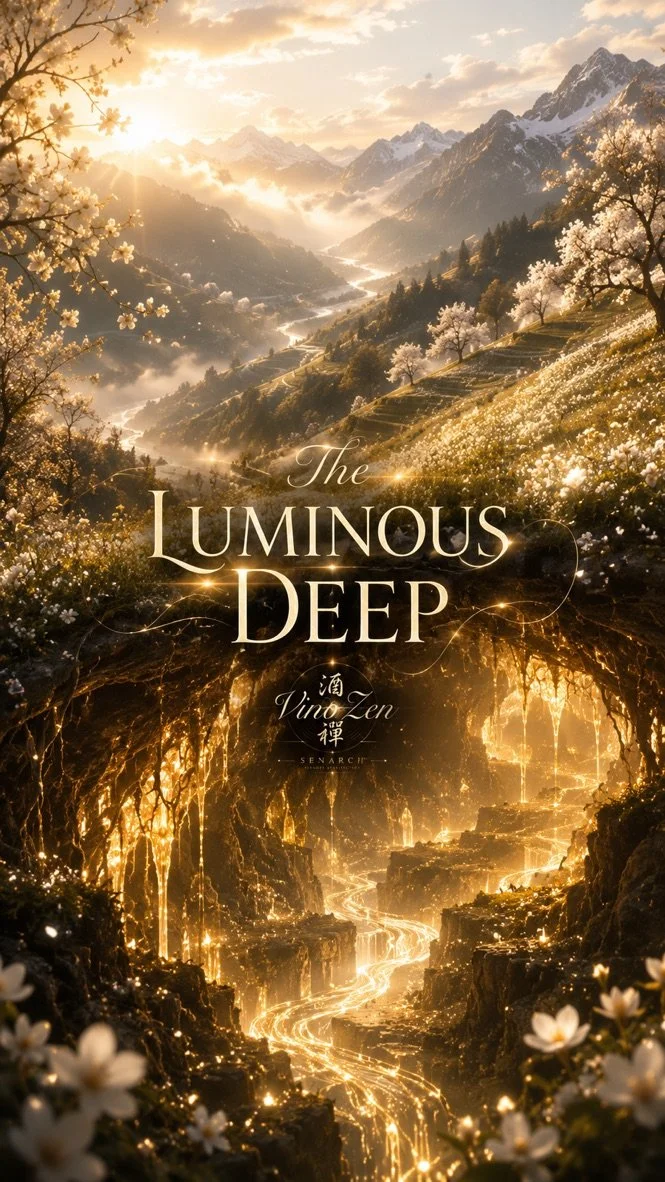
A bright alpine landscape with flowers and distant mountains sits above a much deeper glowing world underneath it, with a river of light moving through the darkness below.
I didn't want to translate Chardonnay into the usual barrels, vanilla, cream or golden fruit.
What interested me more was:
brightness with depth, without heaviness.
Translation
The floral lift and acidity became blossoms, altitude and sunlight.
The oak and texture became the deeper structure underneath the surface.
The mineral line became the glowing current connecting both worlds.
The movement follows that current deeper into the landscape instead of resolving quickly.
This ended up teaching me something pretty early on with SenArch: the process doesn't always have to begin with the wine.
Sometimes the architecture already exists first.
It is almost like picturing a state of being you wish a wine could create, then one day tasting something and realizing:
There you are.
02 — SOVEREIGN BLANCHE
Le Vieux Pin Sauvignon Blanc 2025
Golden Mile & Osoyoos Lake District, Okanagan Valley, British Columbia, Canada
Fruit: 63% Golden Mile, 37% Osoyoos Lake District
13% ABV
Initial Impression
My initial notes were recognizable Sauvignon Blanc territory:
ripe green apple, lime, lemon, fresh grass, asparagus, a hint of gooseberry and bread, followed by a very long finish.
But the fruit wasn't what stayed with me.
It was the texture.
The lees work gave the wine richness and breadth without sacrificing freshness. It felt substantial without becoming heavy, textured without feeling grounded.
The thought that stayed with me was:
texture without losing flight.
I tasted it at the winery during my June 2026 Okanagan trip, and the image of the swan came right there and then.
Inspiration
It took shape within seconds.
A kind of dominating elegance.
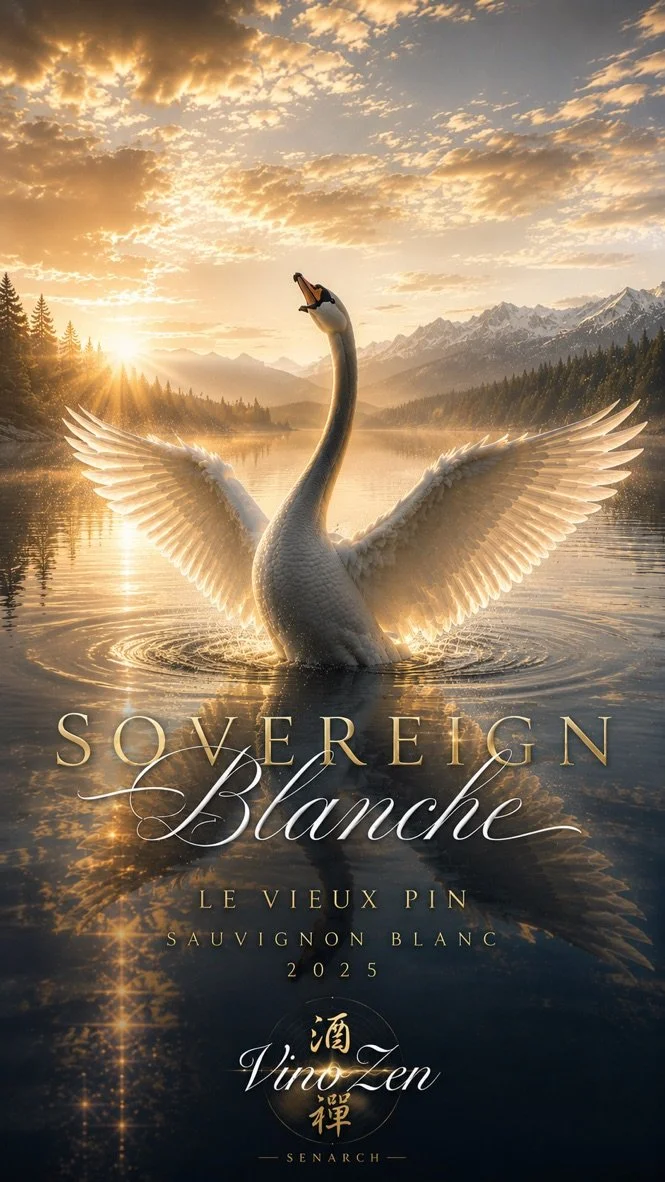
Pearlescent feathers layered densely over the body, almost creamy in appearance, but still reflecting sunlight and water from every direction.
The acidity became the light moving across those feathers.
The lees-derived texture became their density and layering.
The long finish became the open space around it.
The swan needed grace, but it also needed presence.
Its wings could rise because there was enough substance underneath them.
Translation
Acidity became light and altitude.
Lees became densely layered feathers.
Texture became physical volume.
The long finish became the expanding lake and distant mountain horizon.
The music follows the same logic: brightness and upward movement, supported by a richer foundation underneath.
Acidity became light.
Lees became feathers.
Texture learned to fly.
03 — ERRATIC
Martin’s Lane Winery, Erratic Oaks Vineyard Riesling 2024
Oregon Project, Willamette Valley, Oregon, USA
Produced by Martin’s Lane Winery, Kelowna, Okanagan Valley, British Columbia, Canada
11.5% ABV
Initial Impression
This one was remarkably clear almost immediately:
super clean and crystalline.
Off-dry, but not heavy.
There was a composed intensity to it, almost laser-focused, with a finish that just kept going.
Sustained brilliance.
The sweetness was there, but it never made the wine feel round or soft.
The acidity kept everything pointed in one direction.
Intensity without volume.
Laser-focused.
Inspiration
My earliest working concept was actually Fractured Light.
I wanted to avoid turning Riesling into the usual sweetness, glitter and delicate prettiness.
This wine felt much closer to:
light refracting through ice.
Angular.
Electric.
Crystalline.
Slightly unstable.
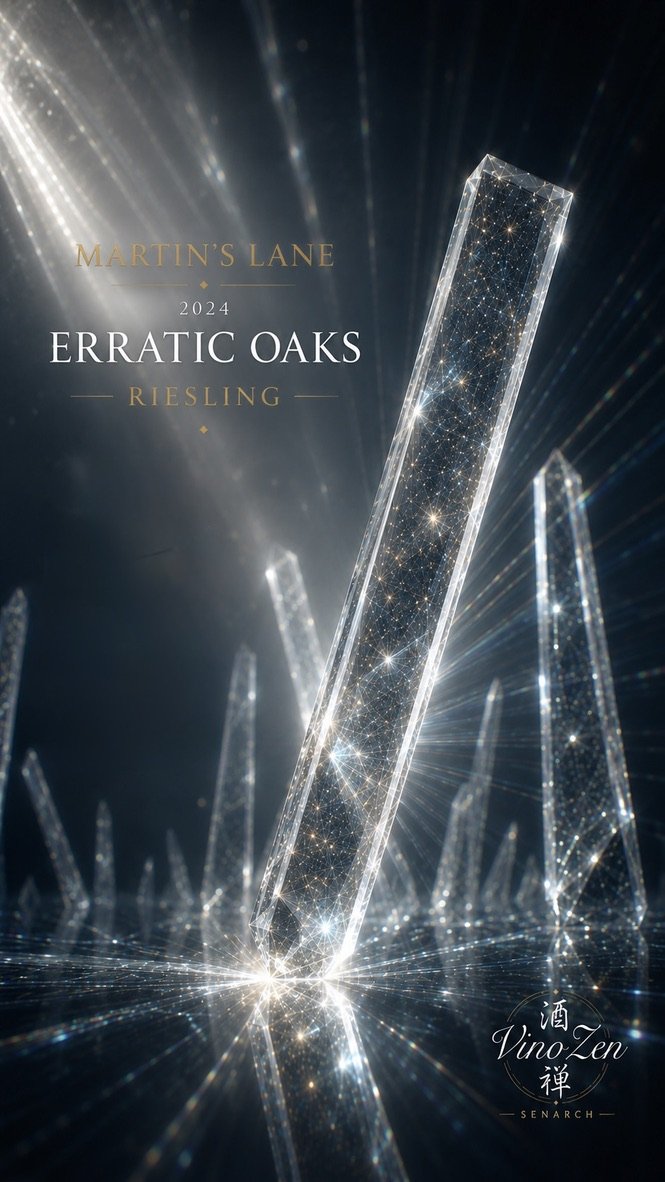
Eventually that became the transparent monoliths in Erratic.
Light enters them, gets split, reflected and multiplied.
The whole structure feels like it is barely holding that energy in place.
Translation
The residual sweetness became the glow inside the crystal.
The acidity became the sharp edges, refraction, tension and direction.
The long finish became the light and constellations continuing through the structure.
The music followed the same idea: brighter sounds, sharper attacks, upward movement, tighter rhythms and more tension instead of making everything lush or soft.
It wasn't simply:
Riesling = crystal.
It was about how this particular Riesling behaved.
Precise.
Focused.
Crystalline.
Persistent.
A little unpredictable.
04 — ATTACK
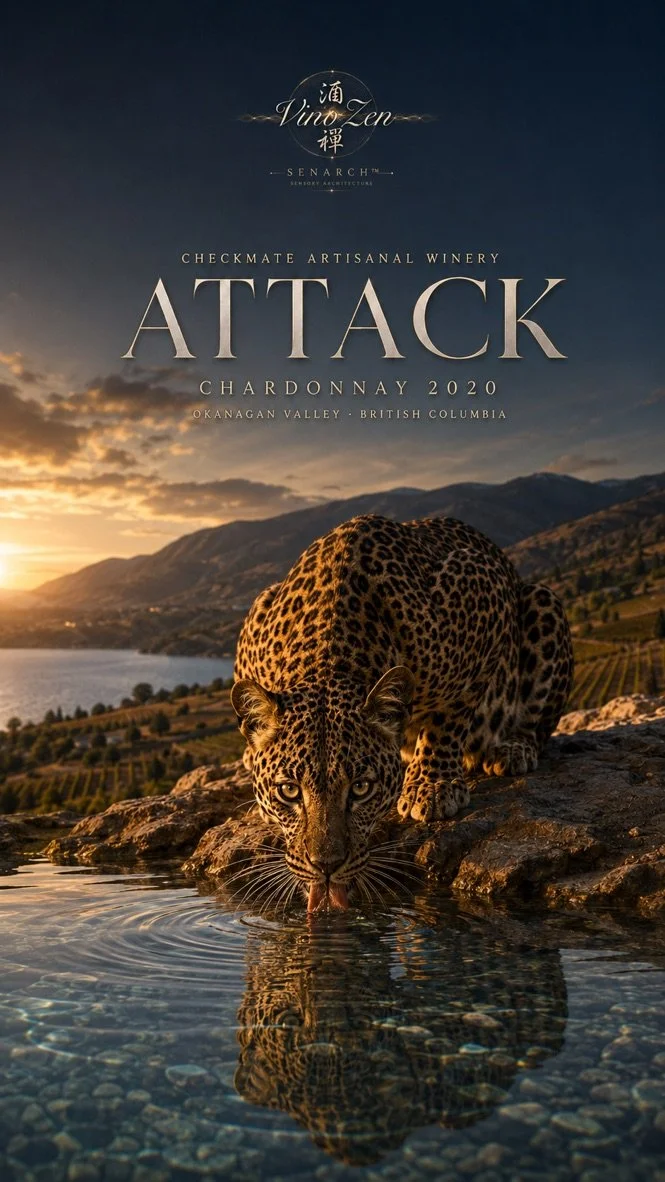
CheckMate Artisanal Winery, Attack Chardonnay 2020
Okanagan Valley, British Columbia, Canada
13.5% ABV
Commentary: I spent some time considering whether to keep this piece in the Selection because of my more recent experiences with the winery. In the end, removing it felt unfair to the wine itself and to the team that created it in 2020. The people, circumstances, and winery I encountered then are not necessarily the same as they are today. So the piece stayed.
For me, Attack now carries another layer of meaning. It is not only a translation of the wine I tasted, but also a record of a particular moment in the life of a winery, and of the people who made that wine possible.
Initial Impression
This wine started much richer than the final image might suggest, mostly because the energy underneath all that richness never disappeared.
Golden.
Buttery.
Leesy.
Ripe apple.
Asian pear.
Nectarine.
Mandarin.
Hints of spice and warm pastry.
Then underneath all of that:
a saline line.
There was freshness running through the wine, but it didn't announce itself right away.
It stayed underneath the richness for a while.
Then:
it pounced.
Inspiration
The leopard came from that contrast almost immediately.
Not a leopard attacking or roaring.
It was drinking from the water, seemingly calm, but still completely alert.
The body could be still while the energy remained there underneath.
That was much closer to what I was getting from the wine.
The richness was obvious, but it wasn't the whole story. There was something tighter and more focused waiting underneath it.
Translation
The ripe fruit, lees and pastry became the warm golden landscape and the physical richness of the leopard.
The saline freshness became the cooler water.
The point where the leopard meets the water became the point where richness and freshness meet in the wine.
For the moving piece, I wanted to start underneath the surface, inside that cooler side of the wine first.
Then the ripple.
Then the camera comes above the water and the warmer landscape opens up.
This was one of the pieces that made movement especially useful to me. Saying a wine has “tension” or “energy” tells you something, but it still leaves a lot unexplained.
Here, I knew exactly what I meant by it:
it waited, then pounced.
RED RESONANCES
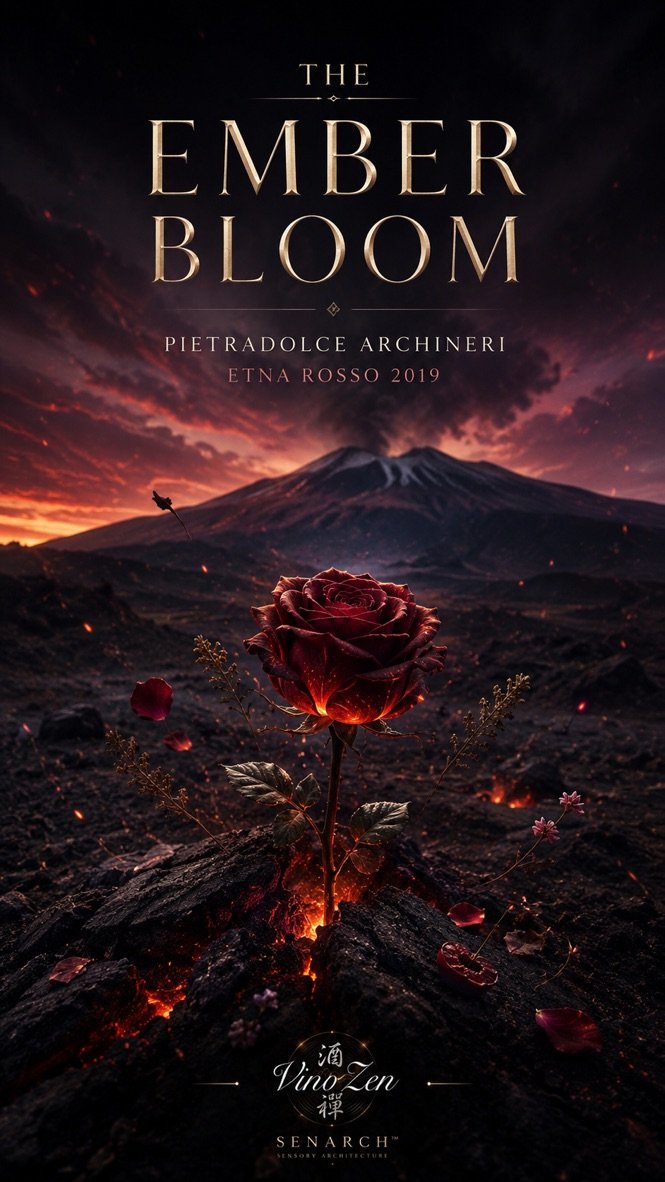
05 — THE EMBER BLOOM
Pietradolce, Archineri Etna Rosso DOC 2019
Nerello Mascalese
Etna Rosso DOC
Etna, Sicily, Italy
14% ABV
Initial Impression
This became one of the most important works in the collection because I arrived at essentially the same image on two separate tastings.
A desert rose.
With dancing embers.
The wine wasn't loud.
It was fragrant, poised and remarkably deep.
What fascinated me most was the way the warmth developed.
The alcohol did not simply register as heat. It seemed to unfold gradually, then ignite additional layers of complexity that kept rising and moving through the finish.
The wine never really felt finished.
Inspiration
That made the flower almost inevitable.
The aromatic lift became the rose.
Etna's volcanic tension became the ground underneath it.
And the slowly developing warmth became the glow coming from inside the flower itself.
I didn't want it to be just a rose placed beside a volcano.
The more interesting idea was that the flower itself seemed to be carrying that volcanic energy.
Translation
The acidity became upward and spiralling movement.
The floral lift became the opening petals.
The fine tannin and volcanic structure became the dark stone and the sense of containment.
The developing warmth became the ember-like glow beneath the petals.
The ash, sparks and heated air kept moving after the flower had already appeared.
So the piece was never just about a volcanic rose.
The defining part was the way the warmth kept unfolding through it.
06 — CELESTIAL MARK
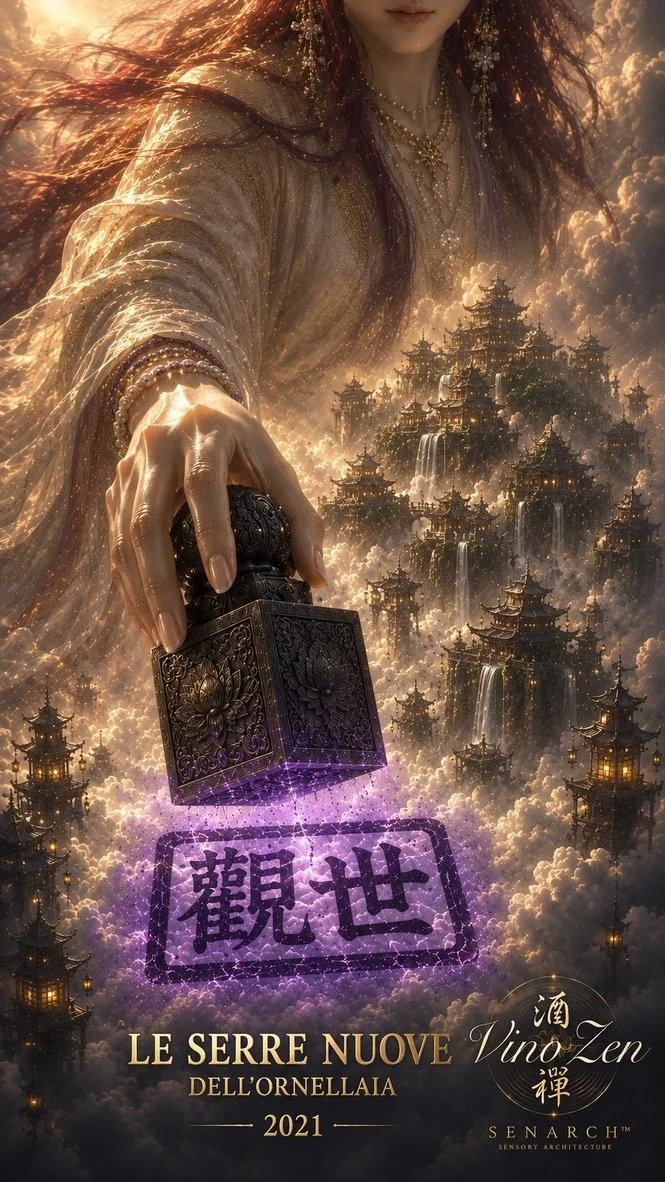
Ornellaia, Le Serre Nuove dell’Ornellaia 2021
Bolgheri DOC Rosso
Merlot, Cabernet Sauvignon, Cabernet Franc & Petit Verdot
Bolgheri, Tuscany, Italy
2021 blend: 50% Merlot, 28% Cabernet Sauvignon, 11% Cabernet Franc, 11% Petit Verdot
14.5% ABV
Initial Impression
My tasting began with:
Fresh blackberry.
Blueberry.
Plum.
Graphite.
Red tea leaf.
Cedar.
A faint impression of ink.
But the most interesting part wasn't the power.
Each sip seemed to open gradually.
Fine tannins.
High acidity that still felt light on its feet.
A complete structure without needing to show off.
Then another sensation started to appear.
Some wines impress.
Some make me admire them.
This felt more like:
recognition.
Almost as if something enormous and compassionate above the clouds had quietly placed a seal on the moment.
Inspiration
That became Celestial Mark, or 觀音贈印, Guanyin bestowing the seal.
The mythology came after the tasting.
What came first was the progression I felt in the wine:
Freshness → Structure → Depth → Authority → Resonance
The image gave me a way to hold all of those stages together in one scene.
Translation
The fresh fruit and acidity became altitude and openness.
Graphite, tea, cedar and ink became the darker lines and materials in the image.
The fine tannin became structure and containment.
The gradual way the wine opened became the slow descent of the seal.
The sense of authority became scale, but without aggression.
And that final feeling of recognition became the moment the seal reaches the world below.
The music follows the same progression. It builds gradually through restrained chamber orchestration, Mediterranean warmth and increasing weight, without becoming overly dramatic.
The deity itself was never really the point.
Recognition was.
07 — A LIFE FROM APALTA
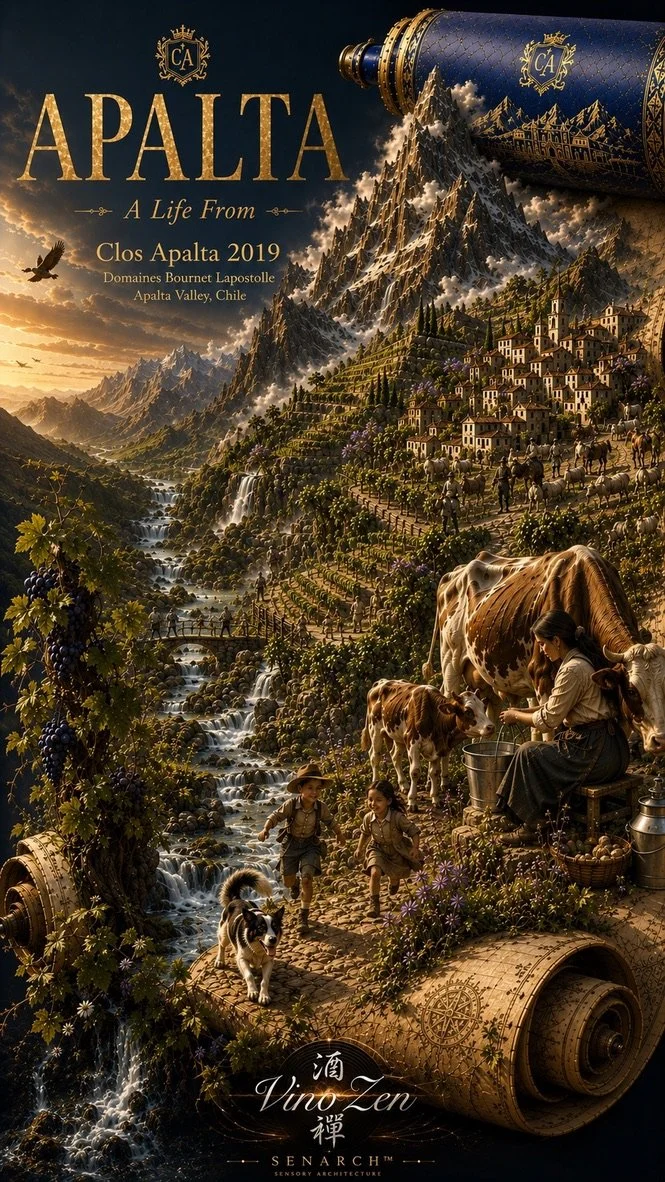
Clos Apalta 2019
Carmenère, Merlot, Cabernet Sauvignon & Petit Verdot
Apalta, Colchagua Valley, Chile
2019 blend: 70% Carmenère, 18% Merlot, 8% Cabernet Sauvignon, 4% Petit Verdot
15% ABV
Initial Impression
My reaction to Clos Apalta became much less about individual aromas and much more about the overall sensation.
The phrase that kept coming back was:
Thriving abundance as a way of life.
The wine didn't feel like it was trying to prove how serious, precise or expensive it was.
Instead, I kept coming back to:
generosity.
warmth.
confidence.
prosperity.
It felt as though the landscape itself was overflowing with life.
That became much more important than any one tasting descriptor.
Inspiration
So I didn't see a château.
I didn't see a throne.
I didn't see a warrior.
I saw a functioning mountain civilization.
Terraced vineyards.
Streams.
Waterfalls.
Houses climbing the slope.
Farmers.
Livestock.
Children.
Bridges.
Vines.
Paths.
Generations living within the same landscape.
Not wealth expressed through possession.
Abundance expressed through life.
The scroll came later as a way to hold the history and memory of that world.
Something that could be unrolled and entered.
Translation
The scale became mountains and long horizons.
The complexity became many lives happening at the same time.
The generosity became flowing water, agriculture and human activity.
The structure became terraces, stone walls and the organization of the village.
The history became the scroll.
For the music, the challenge was avoiding two obvious directions.
Not epic fantasy.
Not cozy pastoral music.
Clos Apalta didn't feel heroic.
It felt flourishing.
So the music became expansive without becoming triumphant.
Cello foundation.
Warm strings.
Restrained horn colour.
Human-scale details.
Community.
Earth.
Mysticism.
The camera doesn't conquer the mountain.
It enters a world that is already alive.
08 — BALASTO
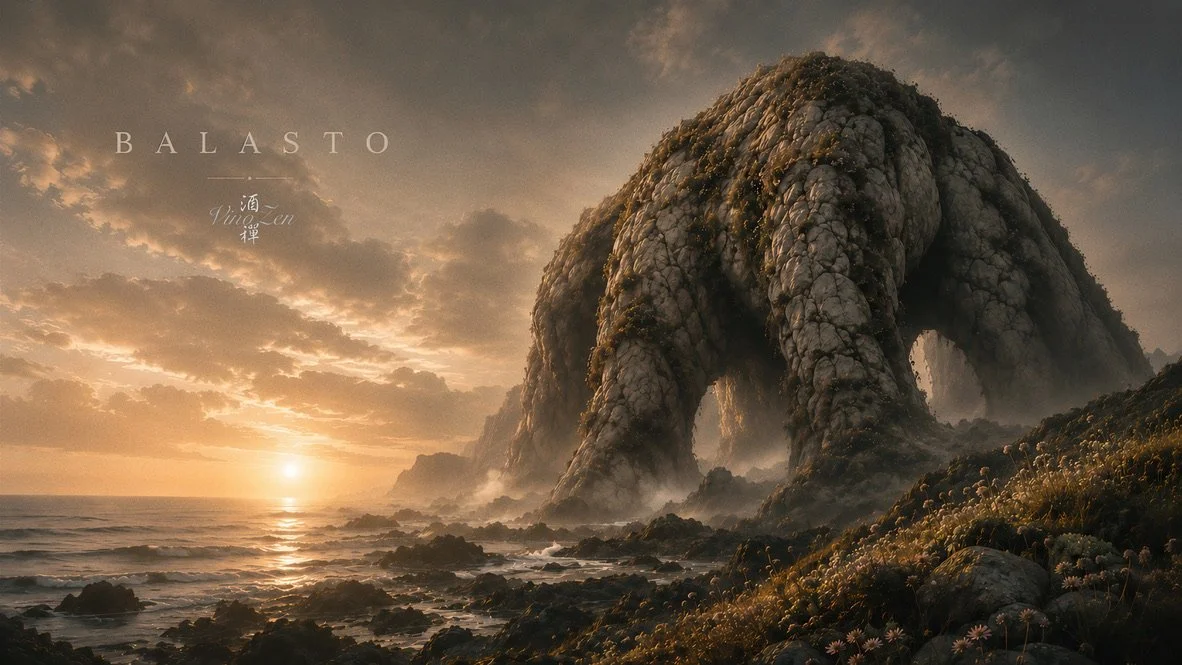
Bodega Garzón, Balasto 2020
Tannat, Cabernet Franc & Petit Verdot
Garzón, Maldonado, Uruguay
14.5% ABV
Initial Impression
Balasto did not seduce.
The first impression was almost immediate:
reserved, towering.
Almost like a giant.
The fruit was there, but it didn't seem interested in impressing me.
Structure came first.
Concentrated without simply feeling heavy.
Powerful without feeling aggressive.
The tannins didn't just support the wine. They seemed to define its architecture.
Then another strangely specific impression appeared:
white soil.
Not just earth.
Not simply minerality.
Dryness.
Powder.
Pale mineral material.
Fine tannin.
Grounded tension.
Somehow, all of those things started to feel like the same thing.
Inspiration
The towering giant was there almost immediately, so the question became what that giant was actually made of.
The answer was stone.
Not polished marble. Not a building or monument.
Something enormous and weathered, standing on the Atlantic coast and shaped by pressure, wind, water and time.
The white-soil impression gave it that pale mineral surface.
There are flowers and life around it, but they don't soften its scale.
The stone still dominates.
Translation
The tannin became the physical resistance and massive stone surfaces.
The white soil became the pale, exposed mineral material.
The concentration became scale.
The Atlantic became movement around something that barely moves:
wind, water, tide, spray and distance.
The music followed the same idea.
Deep foundations.
Broad sustained sound.
Slow development.
Long reverberation.
More geological than melodic.
The giant doesn't need to move.
Everything else moves around it.
SPIRIT RESONANCES
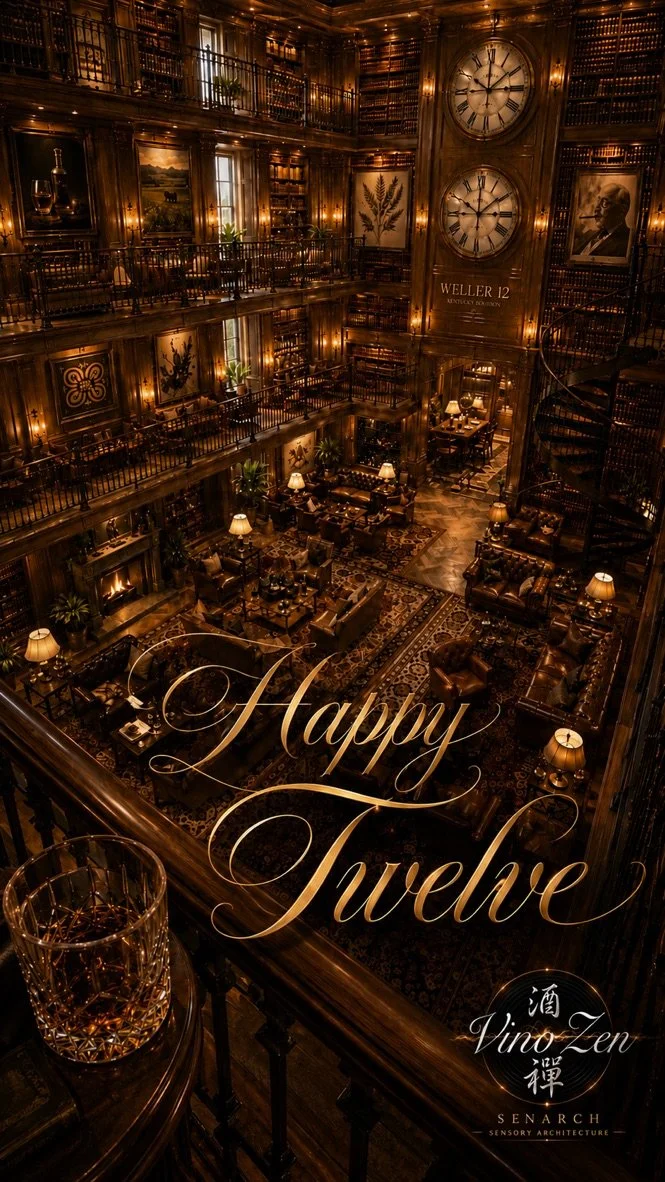
09 — HAPPY TWELVE
W.L. Weller 12 Year
Kentucky Straight Bourbon Whiskey
Wheated Bourbon, 12 Years Old
Buffalo Trace Distillery
Frankfort, Kentucky, USA
45% ABV / 90 Proof.
Initial Impression
Tasted in silence, Weller 12 gave me:
ripe apple, melon, corn sweetness, rye spice, caramel, vanilla and oak.
But again, the tasting list wasn't what stayed with me.
The whisky felt mature without becoming austere.
Old without becoming dusty.
Comfortable without becoming simple.
Inspiration
I kept seeing an old library that had been beautifully restored.
Not a rustic bourbon cabin.
Something more architectural.
Old walnut.
Leather.
Books.
Brass.
Polished surfaces.
An older space, but with enough refinement and restoration that it still felt alive.
And somewhere in the room:
a clock at twelve.
Not exactly subtle symbolism.
But it worked because the twelve years didn't just feel like a number on the label.
They felt built into the whisky.
Time made comfortable.
Translation
The oak became the architecture.
Caramel, vanilla and corn sweetness became the warm amber light.
The fruit kept the room from feeling too heavy or too old.
The age became books, patina and accumulated layers rather than decay.
The clock made the idea of maturation visible.
The music stayed warm, settled and expansive, with the sweetness rising while the oak and structure remained underneath.
The whole piece became less about age as waiting, and more about what happens when time has had enough room to settle into something comfortable.
10 — SPIRITO TRA I BAMBÙ
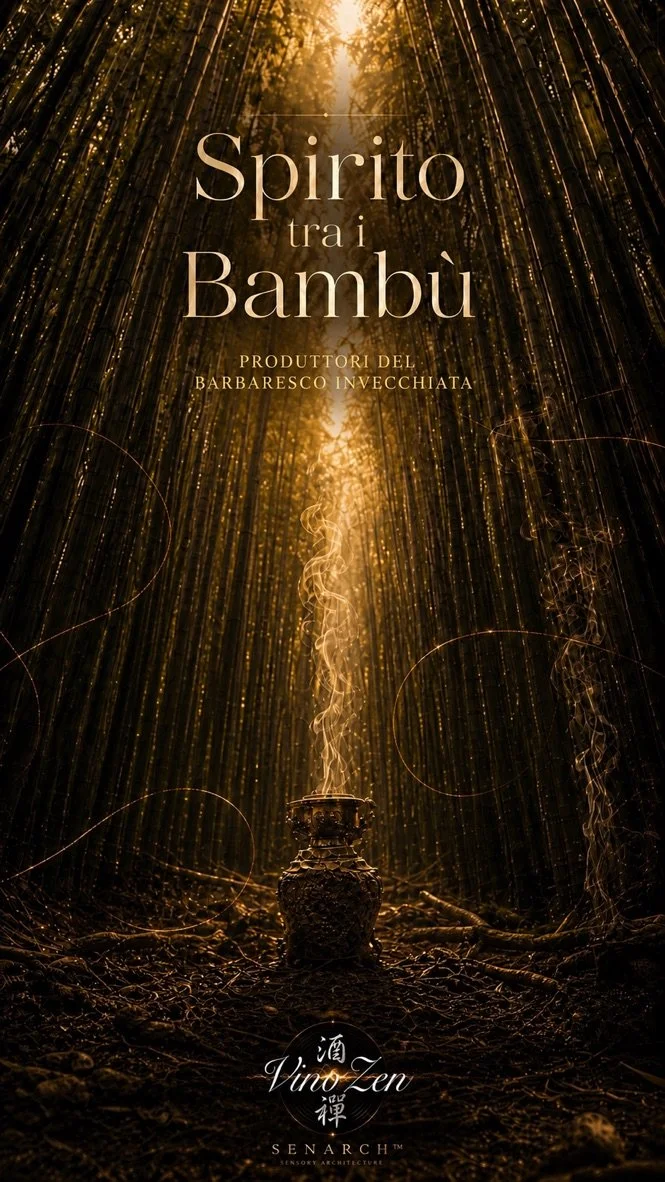
Produttori del Barbaresco, Grappa di Barbaresco Invecchiata
Aged Grappa
Nebbiolo pomace from Barbaresco
Barbaresco, Piedmont, Italy
42% ABV
Initial Impression
My original note wandered pretty quickly away from normal spirit vocabulary:
Gentle wax.
Incense candle.
Grape skin.
Lavender.
Vanilla caramel.
Dates.
Apricot.
Loquat.
It wasn't a loud spirit.
What stayed with me was closer to:
amber light rising through a bamboo forest.
Quiet.
Vertical.
Meditative.
Somewhere between earth, smoke and breath.
Inspiration
The bamboo came from that sense of upward movement.
The grape skin kept everything connected to the wine underneath the grappa.
Wax and incense brought in vapour, ritual and transformation.
The mature fruit and vanilla-caramel warmth became the amber light, but without making the whole thing feel sweet or dessert-like.
At the centre is a small vessel.
Around it, the space feels much larger.
That contrast mattered to me.
The source is small and concentrated, but what rises from it feels much bigger.
Translation
Grape skin became earth.
Age became darkness and wood.
Wax and incense became rising vapour.
Lavender and fruit became the softer aromatic light.
Bamboo became the vertical structure.
The music stayed restrained.
Sparse.
Warm.
Breath-like.
Wooden.
Resonant.
Grappa is already a form of transformation in itself.
Wine leaves something behind, and distillation pulls something else out of it.
That is really where the whole piece came from:
what can still rise from what is left behind?
11 — HIBIKI NO YOIN
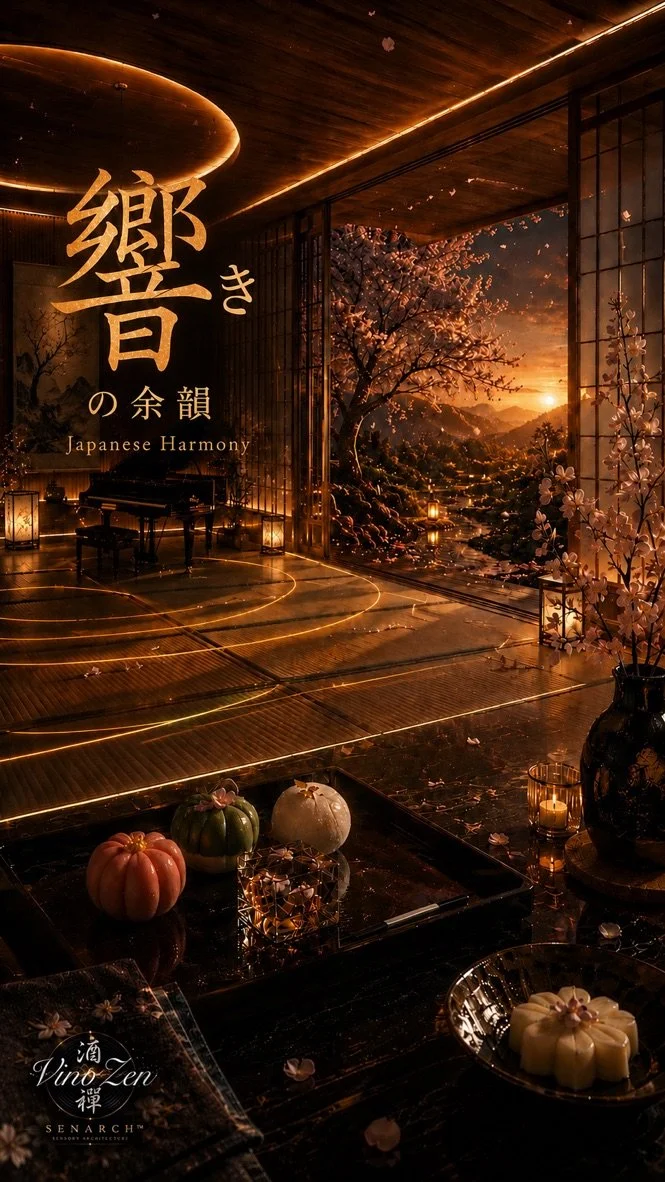
Hibiki Japanese Harmony
Blended Japanese Whisky
Suntory, Japan
43% ABV
Initial Impression
In silence, Hibiki gave me:
pear, light apple, honey, sweet spice, floral notes and cherry blossom.
What stood out was not any one of those things, but how little any of them tried to dominate.
The fruit, sweetness, spice, floral character and oak all seemed to sit in balance with each other. That balance felt much more important than trying to pull the whisky apart into individual descriptors.
Inspiration
At some point I stopped thinking about what each note was and started thinking about what kind of environment could carry the same feeling.
Tatami. Cherry blossoms. Small sweets. Warm afternoon light. A piano. A garden beyond the doors.
Not because Hibiki literally tasted like a Japanese room, but because the whole thing felt composed. Soft, seasonal, deliberate, refined, and very aware of proportion.
That was the shift for me.
Instead of asking what Hibiki tasted like, I started asking what kind of space would make me say:
“That feels like Hibiki.”
Translation
The fruit and honey became the warmth in the room.
The floral character became the cherry blossoms and the movement of petals.
The blend itself became the balance of the whole scene. Nothing should pull too hard in one direction, visually or musically.
The title 響きの余韻, Hibiki no Yoin, came from the idea of resonance and what remains after the sound itself is gone.
That mattered because Hibiki, to me, was never about one dramatic moment. It was about how everything sat together, and how that feeling stayed after the obvious flavours had already passed.
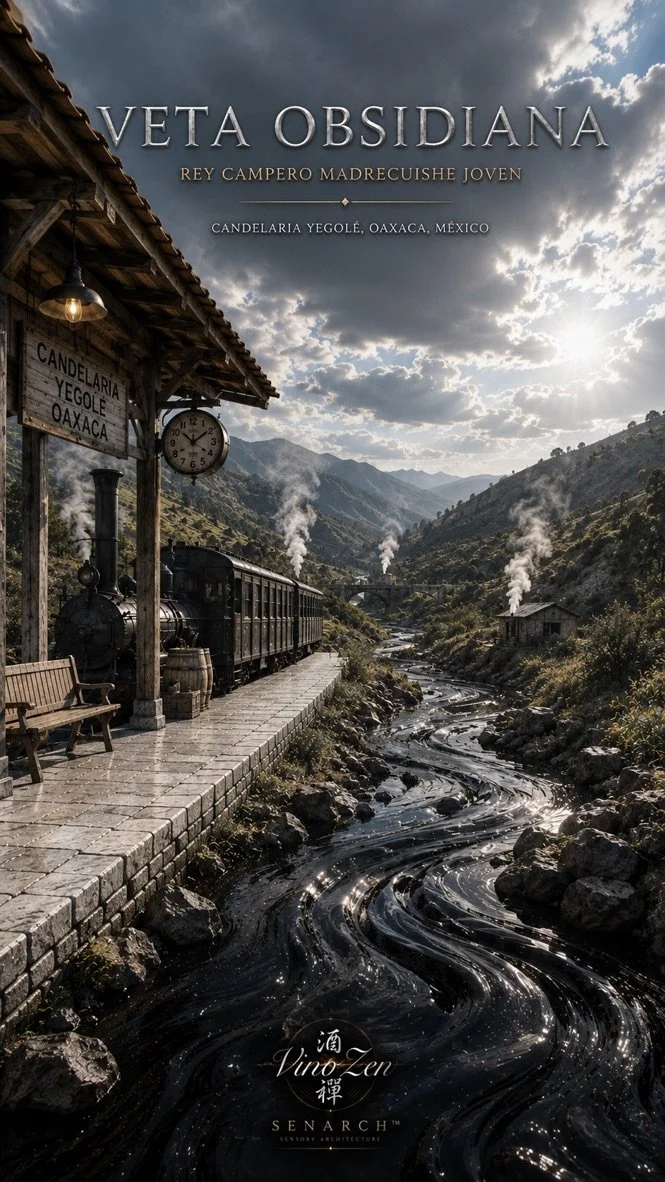
12 — VETA OBSIDIANA
Rey Campero Madrecuishe Joven
Mezcal Artesanal
Madrecuishe, Agave karwinskii
Candelaria Yegolé, Santa María Zoquitlán, Oaxaca, Mexico
48% ABV
Initial Impression
The Madrecuishe came in almost confrontationally.
Overripe pineapple.
Pepper.
Citrus.
Smoke.
Ash.
An almost oily texture.
Then the notes got even stranger:
iron filings.
locomotive smoke.
machine grease.
wet steel.
charred agave fibre.
On paper, none of that sounds especially elegant.
But underneath all of it was something unexpectedly pristine.
Clean.
Reflective.
Almost celestial.
The image I wrote down was:
a dark mirror with almost galactic depth and glints of black gold.
That contradiction was the interesting part.
Inspiration
A lot of spirits feel elegant because the rough edges have been polished away.
This one felt elegant with the rough edges still there.
That was a very different kind of elegance.
The smoke, metal and machine grease naturally pushed the image toward a locomotive.
The earthiness became the dry Oaxacan landscape.
The oily texture became a black vein running through it.
And the strange pristine quality underneath all that roughness made obsidian make sense.
So the world ended up somewhere between industry, geology and something almost cosmic.
Veta Obsidiana.
The obsidian vein.
Translation
Smoke became steam.
Iron, wet steel and machine grease became the train.
Earth and charred agave became the surrounding terrain.
The oily texture became the glossy black current cutting through the landscape.
The pineapple, citrus and aromatic lift were harder to translate literally, so instead they became flashes of light across the obsidian surface.
The movement also had to feel controlled.
The train does not shoot forward.
It starts slowly, mechanically, with weight, then gradually picks up energy.
That pacing felt much closer to the spirit.
And because this is the final track, I liked the fact that the album ends here.
Not in light.
Not in softness.
Back in something physical.
Earth, metal, smoke, motion, and a black reflective vein running into the distance.
SENARCH 2026
Looking at the album as a whole, there is another layer to it that I did not really plan at the beginning.
The sequence itself starts to make sense as a progression.
The Luminous Deep starts with light and depth.
Sovereign Blanche brings in texture and lift.
Erratic sharpens that into precision and focus.
Attack introduces contained energy.
Then the reds shift the album into something heavier and more physical.
The Ember Bloom is about warmth developing through structure.
Celestial Mark moves toward authority and recognition.
A Life From Apalta expands outward into abundance and an entire way of life.
Balasto brings everything back down into mass, tannin, stone and scale.
The spirits move differently again.
Happy Twelve is about comfort, maturity and time.
Spirito tra i Bambù is more about transformation and what rises from what is left behind.
Hibiki no Yoin is about balance and what remains after the obvious sensations pass.
Veta Obsidiana closes everything with earth, smoke, metal, machinery and obsidian.
What I find more interesting, though, is that none of these works really arrived the same way.
The Luminous Deep existed before I found the wine that matched it.
Sovereign Blanche appeared almost immediately as a swan while I was tasting the wine at the winery.
Erratic started with precision, crystallinity and a very specific sense of direction.
Attack came from the contrast between richness and the energy hidden underneath it.
The Ember Bloom gave me almost the same image on two separate tastings, which was when I started taking that image seriously.
Celestial Mark came from a sense of recognition that was much harder to explain through normal tasting language.
A Life From Apalta stopped being about individual flavours altogether and became an entire functioning world.
Balasto gave me a towering giant almost immediately, followed by that strangely specific impression of white soil.
Happy Twelve became an old restored library and a way of thinking about maturity as comfort rather than age.
Spirito tra i Bambù moved upward into vapour, bamboo, incense and transformation.
Hibiki no Yoin became less about individual notes and more about how everything related to everything else.
And Veta Obsidiana somehow found elegance inside smoke, steel, grease and roughness.
That probably explains SenArch better than any single definition I can give it.
It is not meant to replace tasting notes, and I am definitely not expecting someone else to taste the same wine and see my swan, leopard, volcanic flower, mountain civilization or obsidian railway.
Those are my own translations.
What matters more to me is what happens underneath them.
Perception → Structure → Imagery → Meaning → Memory
You notice something.
You try to understand how it behaves.
You give that behaviour some kind of form.
Then sound, imagery, movement and space become other ways of examining the same experience.
The wine or spirit itself does not change.
The experience can.
VinoZen SenArch Selection 2026
12 encounters.
12 original works.
12 sensory worlds.
Track List
01. The Luminous Deep
Blue Mountain Vineyard & Cellars, Block 17, Blossom Slope, Chardonnay 2022
02. Sovereign Blanche
Le Vieux Pin Sauvignon Blanc 2025
03. Erratic
Martin's Lane Erratic Oaks Riesling 2024
04. Attack
CheckMate Artisanal Winery Attack Chardonnay 2020
05. The Ember Bloom
Pietradolce Archineri Etna Rosso 2019
06. Celestial Mark
Le Serre Nuove dell'Ornellaia 2021
07. A Life From Apalta
Clos Apalta 2019
08. Balasto
Bodega Garzón Balasto 2020
09. Happy Twelve
Weller 12
10. Spirito tra i Bambù
Produttori del Barbaresco Grappa di Barbaresco Invecchiata
11. Hibiki no Yoin
Hibiki Japanese Harmony
12. Veta Obsidiana
Rey Campero Madrecuishe Joven
Released August 30th, 2026
Not what something is.
What it becomes when experienced.
Looking at the world, one glass at a time.