
VinoZen SenArch Pilot #2
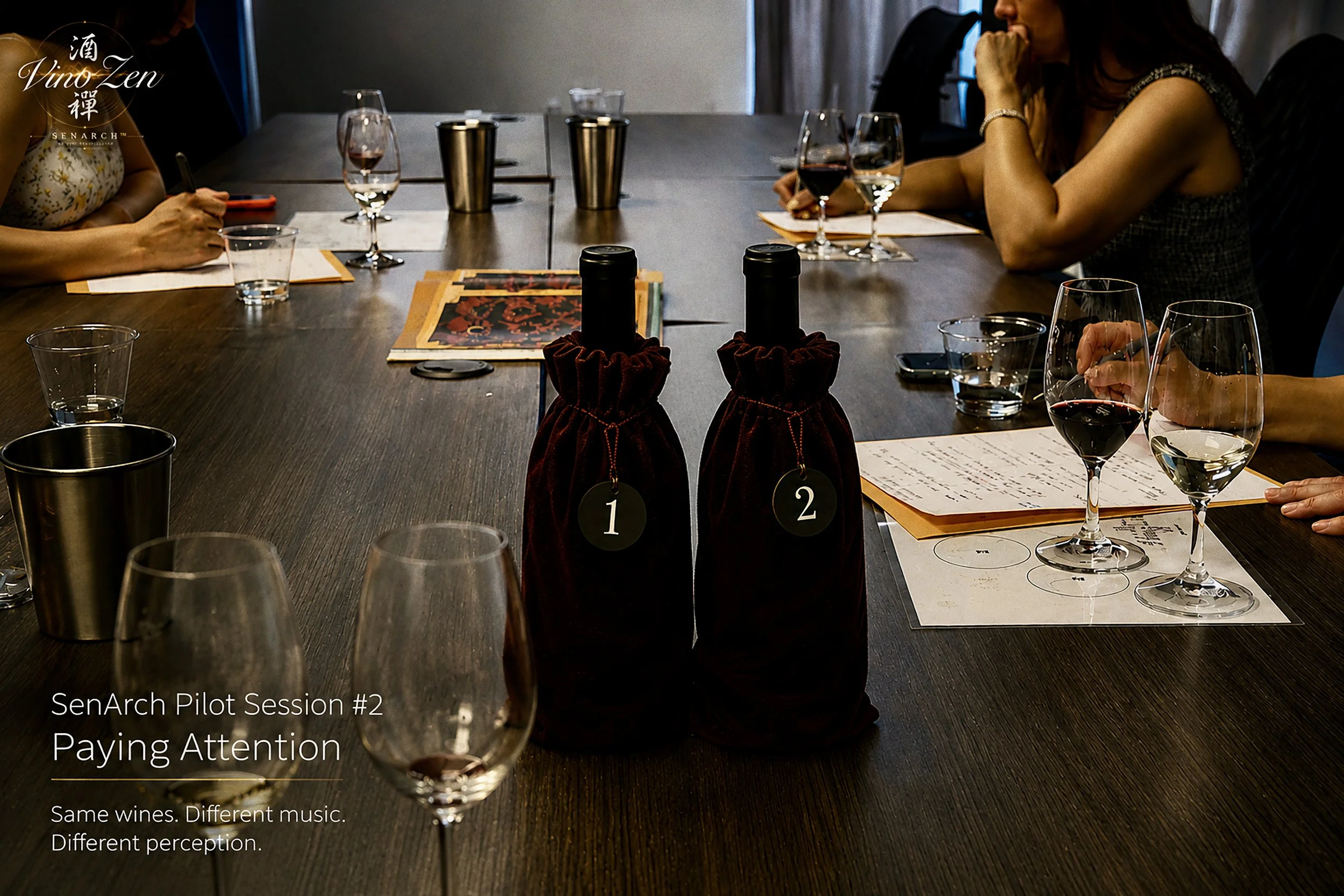
SenArch Pilot Session #2: Paying Attention
Date: June 14, 2026
Time: 7:30 PM
Location: Site B Fountainhead Network, 3012 Murray St, Port Moody
Four people joined the second SenArch pilot session. Some were from the wine industry, some were consumers. Three were attending for the first time, and one had joined the first session on May 24.
This time, I wanted to test something more specific.
What happens when the wine stays exactly the same, but the music changes?
More specifically, I wanted to see if music could shift how people perceived intensity, acidity, sweetness, body, and complexity.
The wines were blind throughout the evening.
We started with both wines in silence. Then I played a priming track with chamber-style oboe and clarinet, a slightly sweeter tone, and a heavier rhythmic section underneath. Some people thought it sounded like tango, which was not the intention, but that reaction itself was interesting.
The first wine was Martin’s Lane Erratic Oaks Riesling 2024. I chose it because of the winery’s reputation for producing world-class Rieslings with precision, focused fruit, vibrant acidity, and an extremely long finish.
The second wine was Caymus Cabernet Sauvignon 2023. I chose Caymus partly because of its polarizing reputation, and partly because the 2023 vintage seemed to have enough acidity, herbal character, and Cabernet definition to make the test more interesting.
Here are some of the findings from the session.
The Riesling worked better with the faster, more energetic chamber track. People described it as richer, more expressive, and more alive. The slower track was still pleasant, but it made the wine feel more restrained and slightly plainer.
Caymus was the opposite.
The slower track worked much better for the group. There was a clear consensus. It made the wine feel more integrated, more complex, and more complete. The faster 120 BPM track had energy, but it did not seem to support the wine in the same way.
One of the most interesting observations came after the priming track.
Several people noticed more savoury notes in the Caymus: leather, spice, wet forest floor, herbs, and Cabernet pyrazine character.
Even more interesting, two people noticed similar changes but reacted differently.
One liked the wine less when those notes became more obvious.
Another liked it more because that was the kind of wine character she enjoys.
That was one of the biggest takeaways for me.
SenArch may not simply make wine more enjoyable.
It may change what people notice.
Preference still belongs to the person.
One participant said she did not enjoy the Caymus in silence, but enjoyed it once the music was introduced.
Another joked that maybe you do not necessarily need to decant wine. You just need music.
Because the wines were blind, there was no label to typecast. Some people thought the Caymus was Italian. One even guessed Chianti Classico. Whether right or wrong, that was fascinating to me because it showed how much the absence of a label can open up perception.
There was a lot of laughter throughout the night, but also many quiet moments. People would taste, pause, smile, shake their heads a little, and then realize something had shifted.
For many, the surprise was not that music influenced wine.
It was how much.
I am not trying to claim we proved anything.
But something happened.
The wines did not change.
What people noticed did.
And that might be the most interesting part.
This is still early. Session by session, I am trying to understand what SenArch can reveal about wine, perception, memory, and attention.
The next pilot will go one layer deeper.