
VinoZen SenArch - Bridging the Gap
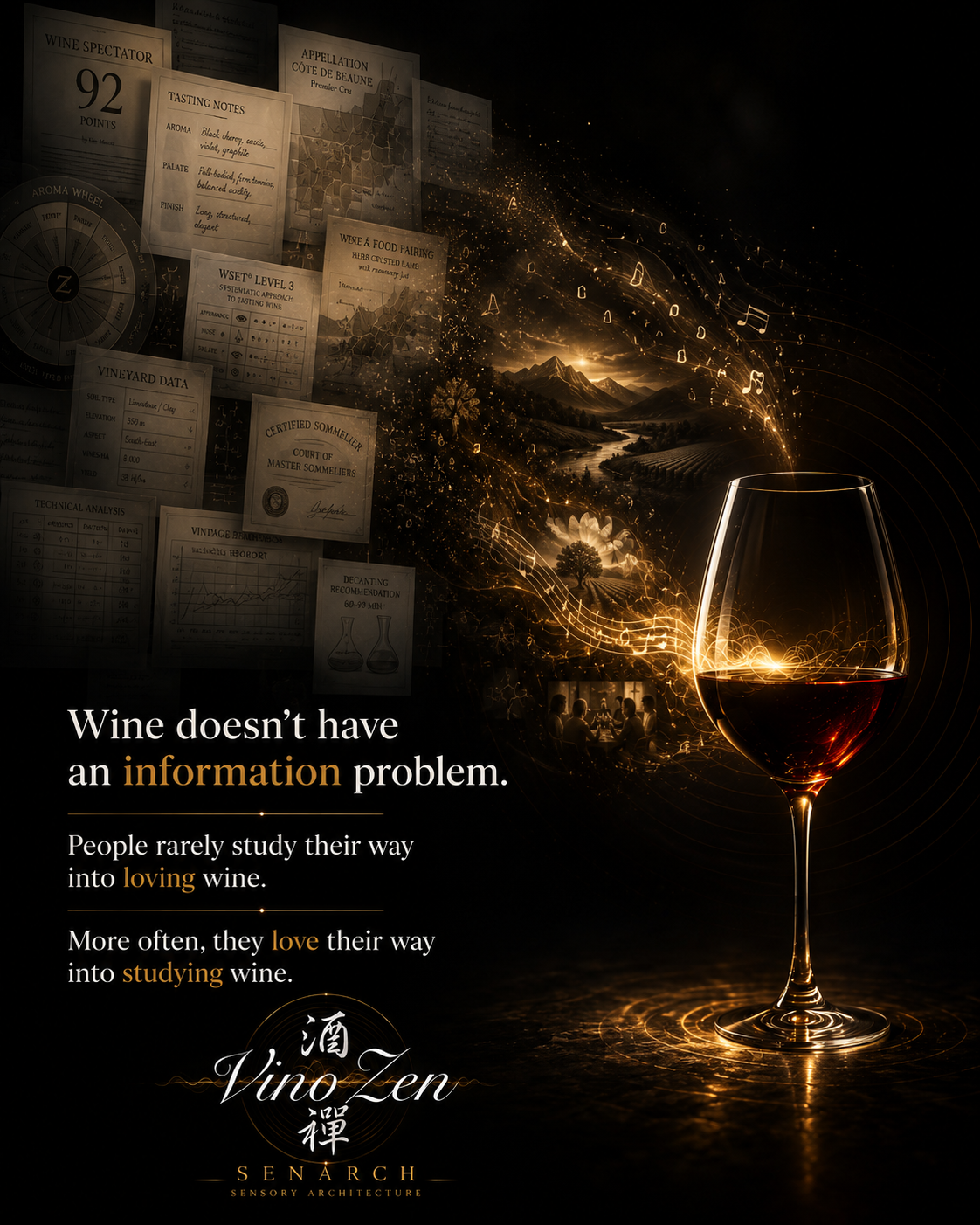
The future of wine engagement will not be won by giving people more information.
It will be won by helping people notice more.
Recent wine-consumer data shows a clear tension. Overall wine participation is declining, habitual consumption is weakening, and wine producers around the world are searching for ways to connect with a new generation of drinkers.
Yet the challenge may not be that younger consumers dislike wine.
Increasingly, the evidence suggests something else.
They are not rejecting wine itself. They appear to be turning away from complexity, intimidation, and the perception that wine appreciation requires expertise before enjoyment.
The emerging pattern is different.
Experience comes first.
Curiosity follows.
Knowledge comes later.
People rarely study their way into loving wine.
More often, they love their way into studying wine.
This matters because much of wine education still assumes the consumer journey begins with information. Grape varieties, appellations, tasting grids, production methods, and quality assessment are valuable tools, but they are often most meaningful after a person already cares. For many newcomers, information can unintentionally create distance. Wine begins to feel like a test before it becomes a pleasure.
Perceptive experiential sensory design approaches the challenge differently.
Instead of asking, “How do we teach people more about wine?” it asks, “How do we create the conditions that help people perceive, feel, remember, and want to explore?”
This is where multisensory and crossmodal research becomes relevant. Research from sensory science and gastrophysics, including the work of Charles Spence at Oxford’s Crossmodal Research Laboratory, has repeatedly shown that perception is not passive. What people taste is shaped not only by the liquid in the glass, but by context: sound, lighting, pacing, expectation, memory, emotion, and attention itself.
Studies have demonstrated that music can influence perceived sweetness, acidity, body, intensity, balance, and enjoyment, while visual and environmental cues can alter how consumers interpret quality, place, and meaning.
Sensory engagement is therefore not merely decoration around an experience.
It can become part of how the experience is accessed.
Early observations from the VinoZen SenArch pilots appear consistent with this broader body of research. Across multiple pilot sessions, participants have reported changes in perceived acidity, richness, freshness, texture, imagery, and emotional tone while tasting the same wine under different sensory conditions.
In one session, participants experienced the same wines under different musical conditions and described notable differences in structure, character, and emotional expression despite nothing changing in the glass.
While these observations remain exploratory rather than definitive, they suggest that carefully designed sensory environments may influence not only what people notice, but how they construct meaning from what they taste.
This has important implications.
A first-time drinker may not have the vocabulary to describe minerality, structure, phenolics, reduction, or regional typicity.
Yet they can still perceive:
Tension and softness.
Energy and stillness.
Brightness and depth.
When people can directly experience these dimensions, wine becomes less abstract.
It becomes more personal.
That personal moment is the conversion point.
The wine industry often focuses on repeat purchase, club memberships, and retention. Beneath all of those metrics lies a more fundamental question:
What makes someone want to come back?
People rarely fall in love with wine because they learned a technical concept.
They fall in love when wine suddenly feels expressive, memorable, and worth paying attention to.
Once that happens, education becomes an invitation rather than an obligation.
This reframes the role of wine education, hospitality, and experience design.
The goal is not to replace technical knowledge.
The goal is to create a bridge into it.
That is the opportunity for SenArch.
SenArch is not simply pairing wine with music.
It is a perceptive architecture for guiding attention.
It uses sound, pacing, atmosphere, and sensory framing to help people access what may already be present in the wine but not yet available to conscious perception.
It does not need to claim that it changes the wine.
The stronger claim is that it changes the conditions of noticing.
The most important measurement may therefore not be whether participants identify more aromas correctly.
A more meaningful question is:
After the experience, do they want to explore wine further?
That is where sensory design connects directly to wine’s current challenge.
The industry does not need more ways to describe wine to people who are already convinced.
It needs better ways to awaken curiosity in people who are not yet convinced.
Wine already has enough information.
What it needs is designed attention.