
SenArch Pilot #3: Can Music Move a Whisky Closer to Itself?
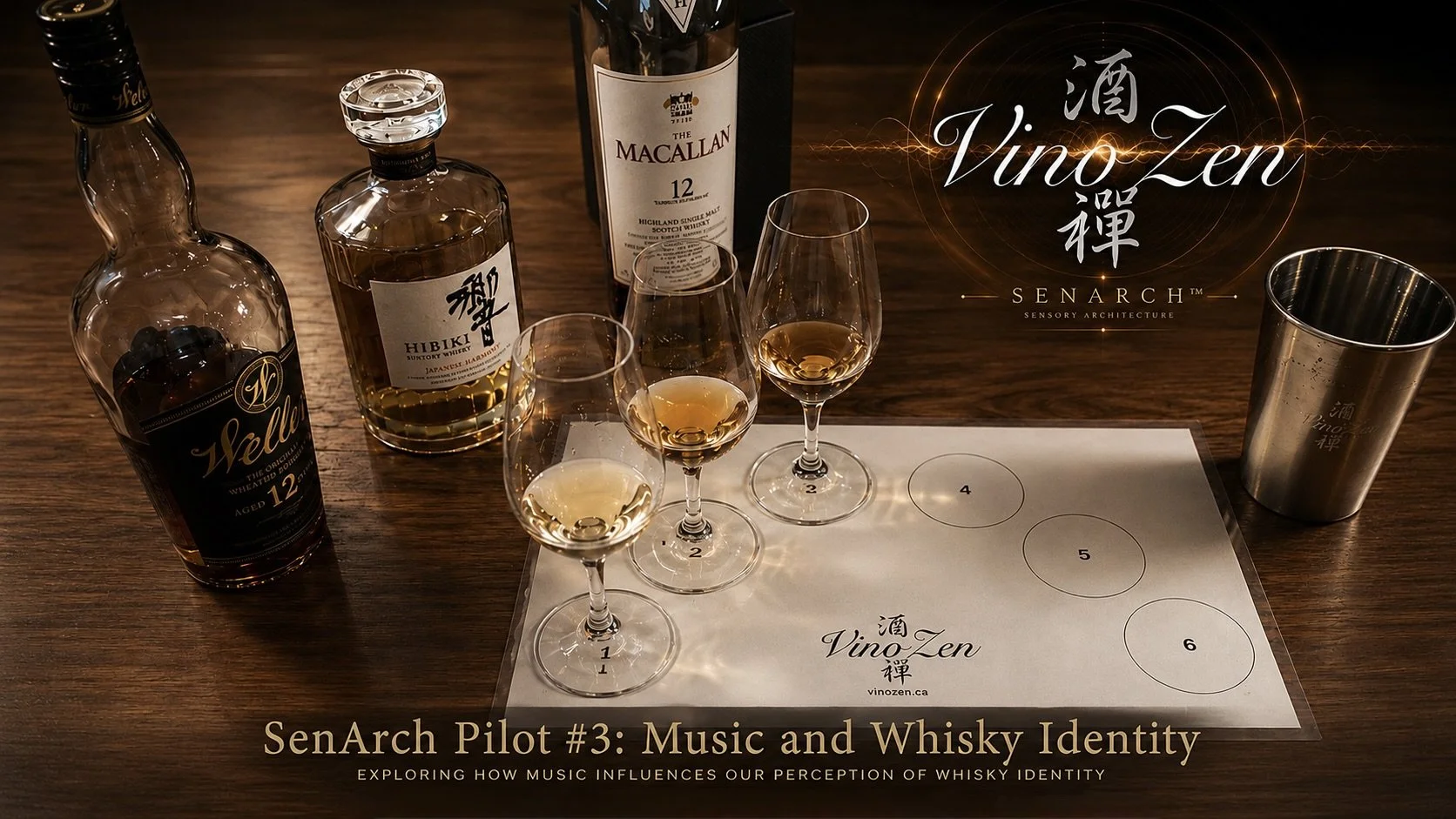
Tasted: July 1st 2026
SenArch Pilot #3 was originally scheduled for June 28, but due to scheduling conflicts, the session had to be cancelled.
In hindsight, that may have been a blessing.
The original plan was straightforward: take a single whisky and explore it through different sensory architectures.
Silence.
Calm.
Power.
Joy.
And finally, a custom-designed track intended to align as closely as possible with the whisky’s identity.
With the public session postponed, I decided to explore the idea myself.
But instead of one whisky, I expanded the experiment to three:
Hibiki Japanese Harmony
Weller 12
Macallan 12
A Lesson From Last Year
One lesson I learned from the 2025 VinoZen Society Canadian Whisky Selection, where we explored 18 different whiskies, is that palate fatigue arrives much faster than most people realize - high alcohol really attacks your palate aggressively and it lasted for days. Read about it HERE: VinoZen Society Selection 2025 - Canadian Whisky
When everything is tasted immediately, subtle differences can quickly become blurred.
So for this exploratory session, I split the process into two parts.
First, I used aroma only.
Each whisky was evaluated in silence and then with three mood-based tracks: Calm, Power, and Joy.
The goal was not to determine whether the whisky became better or worse, but simply to observe what changed.
Only after that did I move to tasting, pairing each whisky with its dedicated identity track:
Hibiki Japanese Harmony with 響きの余韻 (Hibiki no Yoin)
Weller 12 with Happy Twelve
Macallan 12 with Vow of the Glen (unreleased)
The mood tracks explored possibilities.
The identity tracks explored coherence.
What The Mood Tracks Did
Across all three whiskies, some broad patterns began to emerge.
The Calm track, built around high piano notes floating over a subtle 40 Hz foundation, often increased perceived sweetness, richness, fruit, and contemplation.
The Power track, driven by cinematic percussion, low brass, and greater intensity, tended to emphasize oak, spice, structure, varnish, and physical presence.
The Joy track often increased energy, movement, complexity, and stylistic expression.
What surprised me was not that the whiskies changed.
It was how differently they changed.
Hibiki Japanese Harmony
In silence, Hibiki presented pear, light apple, honey, sweet spices, floral notes, cherry blossom, and gentle oak polish.
Under Calm, it became richer and sweeter. Honeyed apple and pear moved forward. The whisky felt more reflective and harmonized.
Under Power, the fruit stepped back while vanilla, oak, caramel, and baking spice became more prominent.
Under Joy, the whisky became unexpectedly expressive. Pomelo appeared. Sweet pastries emerged. The faster pacing seemed to energize the fruit. At one point I even found myself writing down “smoked jerky?” in my notes.
Not because Hibiki suddenly became smoky, but because the experience had shifted enough to reveal something I had never noticed before.
Weller 12
Without music, Weller 12 offered ripe apple, melon, corn sweetness, rye spice, caramel, vanilla, and oak.
The imagery that appeared was different from the other whiskies.
Rather than landscapes, I found myself thinking of oil paintings, fountains, and quiet awareness.
Under Calm, the fruit became richer and softer.
Under Power, the whisky became surprisingly cinematic.
My notes literally read:
“Getting on a fighter jet.”
Fruit stepped back while varnished oak and structure moved forward. Yet somehow the alcohol felt less aggressive.
Under Joy, Weller became the most recognizably bourbon-like. Spice, oak, and integrated orchard fruit all seemed to align.
Macallan 12
Macallan opened with bright apple, pear, malt, oatmeal, sherry, raisins, and a slightly dusty paper character.
The imagery was immediate.
A river.
A landscape.
A figure standing and observing.
Someone playing an instrument somewhere nearby.
Under Calm, Macallan’s signature medicinal and sulfur notes became more noticeable while orchard fruit brightened.
Under Power, those medicinal notes became even more prominent as sweetness stepped back.
Under Joy, the fruit and sulfur seemed to find balance, creating what felt like the most distinctly Macallan expression of the mood tracks.
The Identity Tracks
This is where things became truly interesting.
The dedicated tracks did not necessarily make the whiskies sweeter.
They did not necessarily make them more intense.
Instead, they seemed to make them feel more like themselves.
Hibiki Japanese Harmony + Hibiki no Yoin
This remained my favourite pairing for Hibiki.
Built around contemporary jazz with Japanese koto elements and a slightly faster pulse, the track seemed to bring the whisky together rather than push any single note forward.
The sweetness felt complete.
The character felt coherent.
The richness landed in exactly the right place.
Not necessarily the sweetest version.
Not necessarily the most complex version.
Simply the most Hibiki.
Weller 12 + Happy Twelve
Happy Twelve was the standout pairing for Weller.
The track combines a steady pulse, warmth, modern country influences, fiddle, and a subtle feeling of slowed time.
What impressed me most was its balance.
The corn sweetness remained.
The spice remained.
The varnished oak remained.
Nothing felt exaggerated.
Everything felt integrated.
The result was not a louder bourbon.
It was a more complete bourbon.
Macallan 12 + Vow of the Glen
Vow of the Glen transformed Macallan in a way that is difficult to describe through tasting notes alone.
The medicinal sherry character became warmer.
Deeper.
Richer.
More importantly, the whisky became flowing.
Oily.
Continuous.
The river imagery that appeared during the aroma evaluation returned even more strongly during the tasting experience.
Individual notes seemed less important than the transitions between them.
The experience shifted from observing flavours to following movement.
An Unexpected Observation
One detail I did not expect was what happened when the tracks were accidentally mismatched.
While evaluating the whiskies, I occasionally replayed an identity track against a different whisky.
Hibiki no Yoin brought additional citrus and sweetness to the other whiskies, but did not necessarily make them feel more coherent.
Vow of the Glen emphasized sweet corn and varnish in Weller 12, while pushing Hibiki toward smoke and savoury notes rather than harmony.
These observations were informal and unplanned, but they may prove important.
If future testing confirms this pattern, it would suggest that identity tracks are not simply making every whisky feel better.
They may be interacting with specific characteristics already present within each whisky.
That possibility is far more interesting.
Important Limitations
This was not a formal blind trial.
It was a self-led exploratory session designed to generate observations and future questions.
The strongest limitation was order.
Each whisky followed the same sequence:
Silence → Calm → Power → Joy → Identity Track.
That means the identity track was always the final exposure for each whisky.
Some of the increased coherence I perceived may have been influenced by familiarity, adaptation, expectation, or attention settling over time rather than the music itself.
Future testing should randomize track order and include deliberate mismatch conditions alongside silence and identity-matched conditions.
Another limitation is that the mood tracks were evaluated primarily through aroma, while the identity tracks included tasting.
As a result, this session should be viewed as exploratory rather than confirmatory.
A Different Conclusion
Going into this experiment, I thought I was looking for the best pairing.
I no longer think that’s the right question.
There may not be a single correct pairing.
Mood matters.
Preference matters.
Intention matters.
The mood-based tracks revealed different facets of each whisky.
Some highlighted fruit.
Some highlighted oak.
Some highlighted spice, smoke, sweetness, or structure.
But the dedicated identity tracks appeared to do something different.
They created coherence.
Not necessarily more fruit.
Not necessarily more sweetness.
Not necessarily more intensity.
Coherence.
Hibiki no Yoin made Hibiki feel more like Hibiki.
Happy Twelve made Weller 12 feel more like Weller 12.
Vow of the Glen made Macallan feel more like Macallan.
Other tracks did not make the whiskies worse.
In fact, some revealed fascinating alternative expressions hidden within them.
But the identity tracks seemed to bring the whiskies home.
This session did not prove that custom music increases whisky identity coherence.
What it did do was reveal a testable idea:
Music may move a whisky closer to, or farther from, its perceived identity.
And that may be the most interesting question SenArch has asked so far.