
Let Consumers Be Consumers— Just Better Equipped
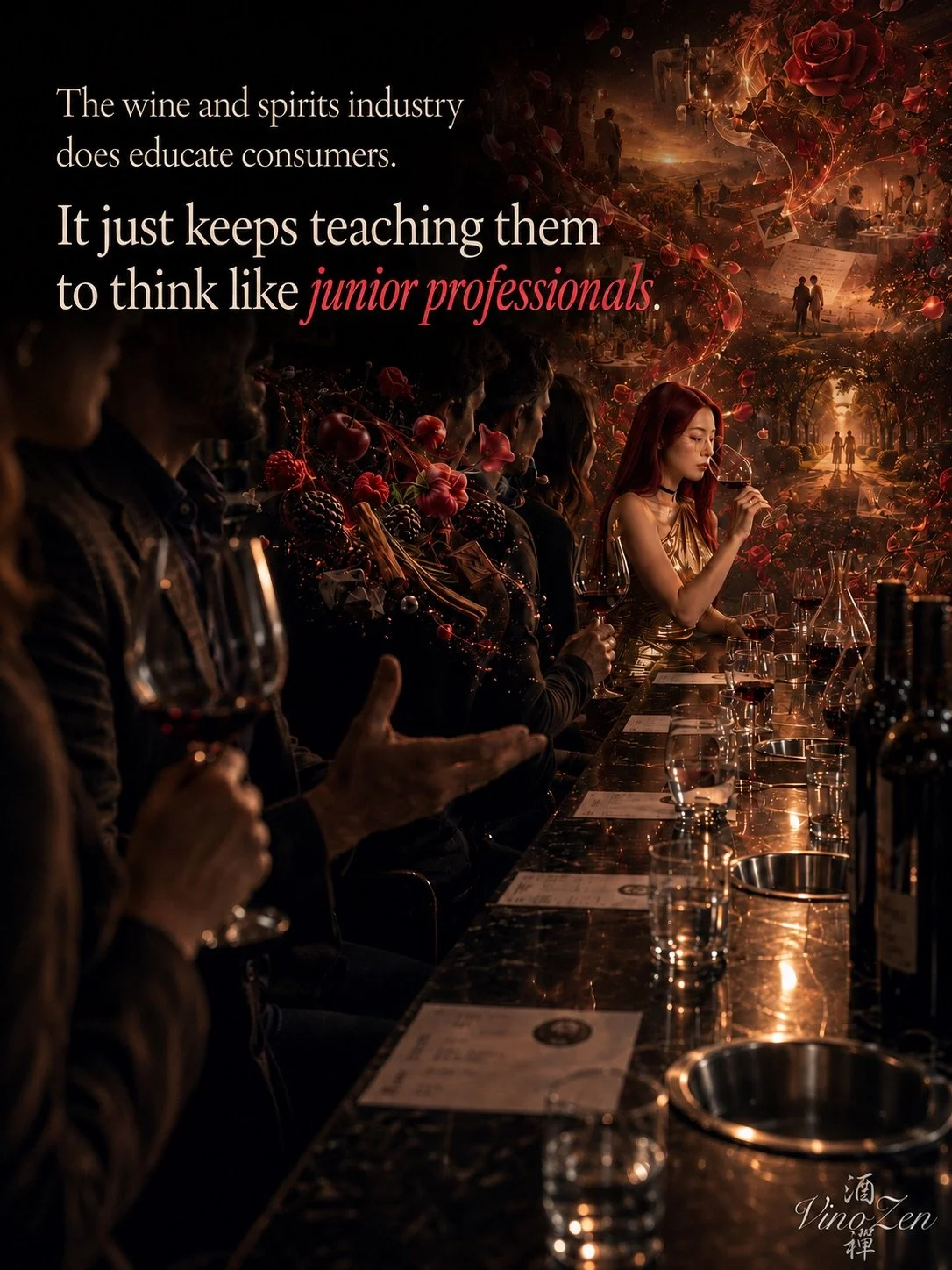
“The wine and spirits industry does educate consumers. It just keeps teaching them to think like junior professionals.”
To test whether that impression held beyond my own experience, I used three leading AI models in parallel as data-gathering and research tools. I asked them to map current British Columbia and international organizations, extract their mandates, programs and performance measures, and identify the strongest counterexamples. I wasn’t asking AI to tell me what to think. Where findings conflicted, I returned to the organizations’ own plans and published reports. Some details changed, but the overall pattern became clearer. Selected primary sources are provided at the end of this article.
The finding wasn’t that consumer education doesn’t exist. Of course it does. The finding was that two established systems approach the consumer from opposite directions and leave the same space underdeveloped. One works outward from the needs of producers and the industry toward the consumer. The other begins with the learner but usually moves them toward professional modes of knowledge, language and assessment.
Industry associations invest heavily in production, research, regulation, advocacy, market development, tourism and promotion. Consumer education is present, but it is typically nested inside market development or regional promotion, with institutional success expressed through measures such as awareness, preference, visitation, reach, demand and sales. Wine Australia is unusually explicit about its purpose: it defines market development as increasing demand and the premium paid for Australian wine, while its Australian Wine Discovered educational platform sits within marketing. Wine Growers British Columbia follows the same general pattern through its focus on marketing, communications, advocacy, brand and demand.
On the other side, organizations such as Bordeaux’s wine school, WSET and regional academies offer real—and sometimes excellent—education. Yet much of that education, once structured, still converges with professional training: more geography, production knowledge, standardized vocabulary, analytical tasting, classification and quality assessment. Consumer wine societies preserve a more convivial form of appreciation, but usually as a membership activity rather than as general-public education at institutional scale.
I should be clear: I teach WSET, and VinoZen Academy offers WSET qualifications. I believe strongly in their value. WSET does what it was designed to do exceptionally well: build structured knowledge and analytical tasting competence. Much of my own ability to pay attention developed through Diploma-level study, especially through the discipline of analytical quality assessment. My argument is not that WSET should become something else. It is that professional education cannot be expected to represent the whole of consumer education.
There are important emerging exceptions. The strongest counterexample I found is the new Wine Scholar Guild Tasting Diploma, which explicitly moves beyond rigid analytical models to explore perception, memory, language, cultural context, emotion and personal voice. It is genuinely developing the bridge between analysis and appreciation.
Yet it is delivered as a nine-month advanced diploma for experienced students, professionals and serious enthusiasts. It expects strong foundational knowledge and meaningful tasting experience, includes formal assessments and carries clear professional and career relevance. That does not make it less valuable. It makes the boundary clearer. WSG is bringing human-centred tasting into advanced wine education; it is not making experiential literacy the starting point of the general consumer’s journey.
One side has institutional influence but largely treats the consumer as demand to activate. The other develops knowledge but still usually moves the learner toward the technical endpoint of the trade. WSG shows that this boundary is beginning to move. What remains underdeveloped is an accessible, consumer-first bridge between knowing and experiencing.
Traditional education starts by teaching people about wine and hopes that knowledge becomes love. Sometimes it does. Sometimes it doesn’t. Consumer-first education can begin in the other direction: help people discover what they love in the experience, and they will want to learn more.
That curiosity can last a lifetime.
But when we talk about wine appreciation, what are we actually appreciating?
Much of what we call wine appreciation is, in reality, analytical tasting. We learn to identify aromas, describe acidity and tannins, assess balance, judge complexity and evaluate quality. These are invaluable skills. They often help us perceive things we might otherwise overlook.
But analysis is a means, not the destination.
Analytical tasting asks, “What is this wine?”
Appreciative tasting asks, “What more can this wine reveal?”
The first seeks understanding through description. The second seeks understanding through attention. Analytical tasting teaches us to identify. Appreciative tasting teaches us to notice.
Appreciation is not the opposite of analysis. It is what analysis should make possible.
A professional must assess consistently, communicate accurately and often set personal preference aside when evaluating quality. Consumers may value those same skills, but they also need to understand their personal preferences, articulate them, test them and gradually expand them.
Someone can correctly identify acidity, tannin, oak, grape variety and origin, yet still freeze when asked, “What do you actually enjoy—and why?” They may recognize blackberry, cedar, graphite and fine tannins, yet still miss the quiet elegance of a wine that continues to unfold with every sip.
Proper consumer education should balance technical literacy with experiential literacy. It should help people perceive the details that make one wine different from another, understand the choices made by the grower and winemaker, and recognize how their own responses change as the wine develops in the glass.
It should help them distinguish familiarity from genuine preference and connect what they taste with imagery, emotion, meaning and memory. It should help them recognize the feeling a wine leaves behind.
Spirits reveal a related gap, perhaps even more sharply. For many consumers, the encounter is framed by the serve or occasion—a shot, highball, cocktail or familiar neat pour—rather than by deliberate attention to the spirit itself. Each can be enjoyable and culturally meaningful; cocktails in particular can be sophisticated works of craft. But the format alone does not develop appreciation of the underlying spirit—its texture, structure, distillation and maturation choices, dilution, evolution and finish.
Accessible education that helps the general public experience spirits on their own terms appears even less developed than it is for wine.
This is not about telling people what to like. It is about helping them perceive more clearly, understand their own responses and participate with greater confidence.
Technical content is easier to standardize, test and scale. Genuine appreciation is slower, more personal and harder to place on a dashboard.
Harder—not impossible.
We can measure articulation, perceptual discrimination, willingness to explore, confidence and recall.
A more capable consumer may not drink more. That isn’t the point. They can demand better, recognize meaningful differences and become less vulnerable to mediocre products dressed up as premium.
That improves the quality of demand.
The current system does not require that kind of consumer. Scores, critics, classifications, price and prestige can reduce uncertainty and produce a purchase without developing the drinker’s own perception. The industry certainly cares whether the consumer is satisfied and buys again. What it rarely measures is whether they understand why—or whether the experience leaves them better equipped for the next glass. Once confidence borrowed from an external authority has been converted into a sale, there is little institutional incentive to help the consumer build confidence of their own.
This is where SenFlow and SenArch connect the two sides. SenFlow makes product knowledge usable through better interaction, preference discovery and confidence. SenArch develops the deeper journey from perception through structure and imagery to meaning and memory.
They do not replace technical education.
They complete it.
The missing piece is not consumer education. It is accessible consumer education actually designed for consumers—education that allows knowledge to deepen experience and experience to create the desire for knowledge.
Because the greatest compliment we can give a wine isn’t simply that we understood it.
It’s that we still remember it.
Selected primary sources for the institutional audit
Accessed July 14, 2026.These are the organizations’ own strategies, mandates, curricula and program descriptions. The interpretation presented in the article is mine; these sources document the institutional structures from which that interpretation was developed.Wine Australia — Strategy and planning. Its 2025–30 plan defines its sector responsibilities through research and innovation, market development and regulatory services. Wine Australia describes market development as increasing demand and the premium paid for Australian wine.Wine Australia — Australian Wine Discovered. An extensive educational platform located within Wine Australia’s marketing activities.Wine Growers British Columbia. Its stated institutional priorities centre on representing BC wineries through marketing, communications and advocacy, supported by strategic goals around brand, advocacy and demand.Wine Growers British Columbia — BC Wine Ambassador Program. A structured, BC-specific program covering the province’s regions, climate, varieties and wine styles.WSET — Level 3 Award in Wines. An advanced qualification for professionals and enthusiasts covering grape growing, winemaking, wine style and quality. Students learn to describe wine characteristics and evaluate quality using the Systematic Approach to Tasting.WSET — Systematic Approach to Tasting. WSET’s standardized framework for observing, describing and evaluating wines and other beverages.WSET — Level 4 Diploma in Wines. An expert-level qualification emphasizing production, business, analytical skills and evaluative tasting.Wine Scholar Guild — Tasting Diploma. The strongest counterexample identified. This nine-month advanced program combines sensory science, critical thinking, mindful observation, memory, cultural context and personal voice while retaining prerequisites, assessments, a formal credential and professional relevance.École du Vin de Bordeaux. A substantial consumer and professional education program operated by the Bordeaux wine interprofession, offering accessible workshops alongside professional training.Rioja Wine Academy. The official educational platform of the DOCa Rioja Control Board. Its pathway extends from introductory enthusiast and tasting courses to professional, tourism and educator qualifications, with certification issued by the Control Board.Champagne Education. Official Champagne education for enthusiasts, students, hospitality, distribution, educators and other professionals, supported by the Comité Champagne.Comité Champagne. The joint trade body responsible for protecting and promoting the Champagne designation and supporting its economic interests and global standing.Japan Sake and Shochu Makers Association. An important boundary case. Its formal activities support production, distribution and promotion, but it also explicitly seeks to help people discover the joys of sake and shochu and enrich their drinking and dining experiences.International Wine & Food Society. A consumer-oriented appreciation society organized around education, tastings, dinners and the shared pleasures of wine and food—an example of appreciation operating primarily through membership rather than as an industry-wide consumer-development mandate.