
Prologue
Azure waters, calming winds, mild waves, and loosely scattered clouds artistically painted the blue skies reaching as far into the horizon as the eye could see. On an undocumented date in April 1901, off the picturesque coast of Antikythera, Greece, young Nikolas sat casually on what looked like a wooden plank, legs playfully splashing the water, causing sparkles in the sunlight. Nikolas had been perfecting his own flotation device; he had shaved the borders rounder and added some hollow pockets to assist with stabilization. As he rode the rhythmic ups and downs on his makeshift surfing board, he looked onto a wooden boat not too far away, just like he did any other day.
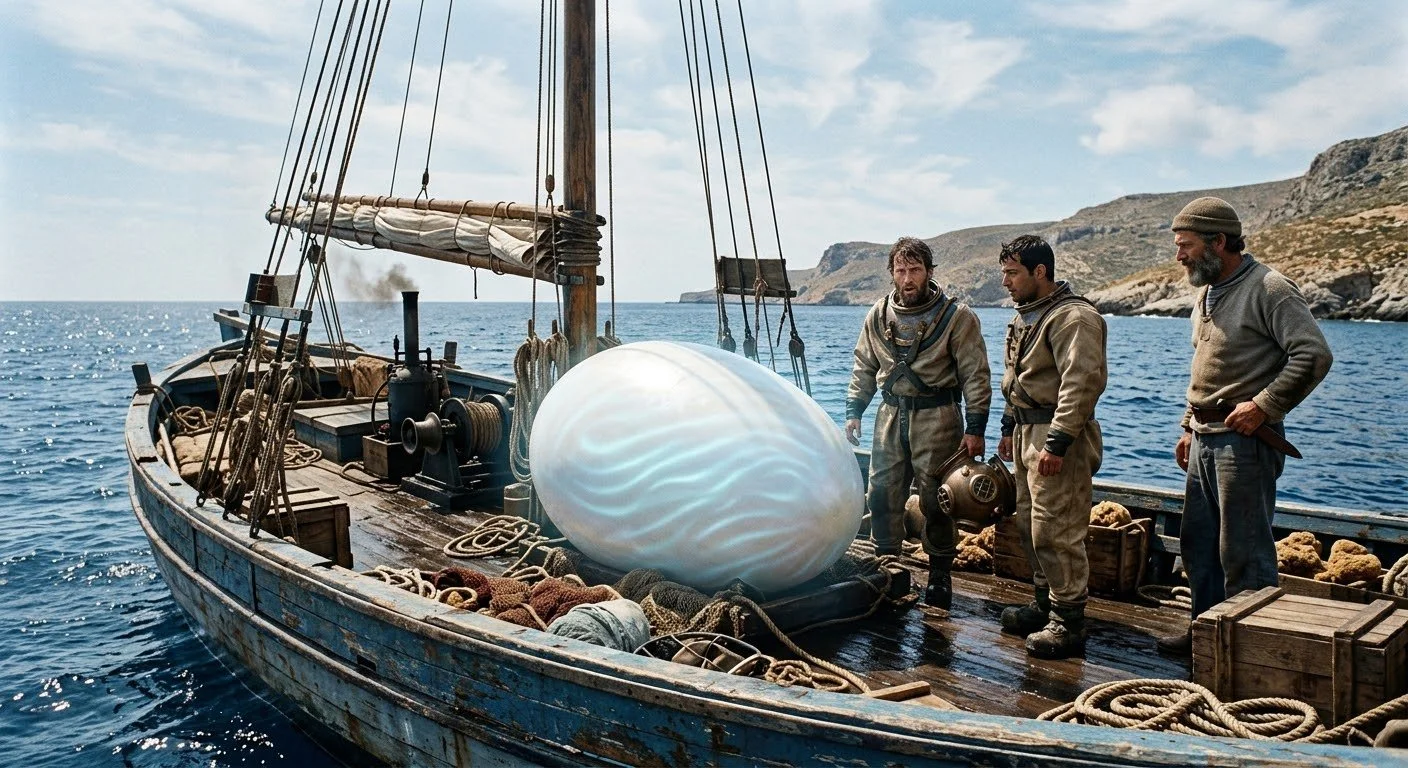
Captain Dimitrios Kontos had dropped the iron anchor to the seafloor and was getting his crew of sponge divers ready to earn a hard day’s work. The boat, a sturdy wooden vessel about 15 metres long, bobbed gently on the waves. Painted a weathered blue with a broad, flat deck, it was equipped with a single mast and a small, steam-driven engine. Coiled ropes and nets lay scattered around, and an old hand-crank air pump stood ready for use.
The sponge divers, donning heavy skafandro suits, adjusted their gear and prepared for the dive. Amongst the group were Nikolas’ older brother, Elias, and his close friend, Fotis. Elias, with his usual meticulous care, checked the air hose connected to the manually operated pump on the surface, ensuring everything was in order.
Nikolas stood up on his board, balancing effortlessly as he waved to Elias. His brother returned the gesture with a smile that’s both protective and proud. Fotis, ever the joker, mimicked Elias’s wave in an exaggerated manner, causing both brothers to chuckle.
Captain Kontos barked orders, his voice carrying across the water. The crew sprang into action, each man knowing his role. With a final thumbs-up from the divers, Elias and Fotis began their descent into the depths. Nikolas watched as his brother and friend jumped into the sapphire surface. Still standing on his board, he subconsciously accounted for the board’s subtle balancing dynamics while looking into the depths as the divers disappeared into the underwater shadows.
The familiar cold pressed against Elias through his loose diving outfit, from his calves to his chest and over his helmet. His view transformed from blue skies to blue waters just as he opened his mind to be fully aware of his surroundings. At around 20 metres deep, the group reached a narrow shelf just off the coast. Their helmets allowed only limited vision, so they had to rely on touch to find and collect sponges.
Elias took out a knife to carefully cut the sponges loose from rocks and coral. He had been doing this since he was fifteen—over a decade of diving. He knew the water, knew the underwater life, knew where sponges would grow.
But his knife hit something he had never felt before. A dull knock stopped his hand mid-motion. Curious, Elias reached out with his other hand to part the sand and rubble around the blade. What emerged was smooth and pale—pearly white, almost glowing even through the tiny window of his helmet.
Fotis, nearby, saw the shape too. He half-swam, half-hopped over to Elias’s side. They exchanged puzzled looks. Elias motioned upward with his hand, pointing toward the underwater sky.
It took the crew two trips between the boat and the underwater anomaly to confirm what was there and secure it with heavy-duty lines. Even with the seemingly stubborn marine build-up, they came off with unexpected ease. What remained was an egg-shaped object nearly three metres long and one and half wide at its thickest, it was oddly smooth—and surprisingly light. Elias and Fotis guided the object while the crew on the boat used the anchor winch, driven by the steam-driven engine, to perform the lift.
Nikolas, still on his board, had watched the movement in the water from a distance. Curious, he started paddling closer as the object surfaced. Just as Elias and Fotis braced it against the hull for the crank lift, the egg’s pearly white shell began to pulse—faint, deliberate waves of pale blue slipping beneath the surface.
Nobody noticed at first. The crew was focused, water dripping from their suits, eyes fixed on the lines and crank. Only when the egg cleared the water and hung briefly in midair did someone pause.
Then they all saw it:
something they had never seen before, doing something they had never seen before.
The egg landed on the deck with a muted, almost hollow thud. Seafoam clung to its skin as it continued to pulse—quiet, steady, and strange.
No one spoke. A few exchanged glances. Elias shifted his weight like he wanted to say something but couldn’t find the words.
Then Fotis stepped forward and gently tapped it with the handle of his knife. A crisp, high note rang out—neither metal nor wood.
“Can’t believe it weighs almost nothing,” Fotis muttered. “Feels like gut air. What do you reckon it’s worth, re?”
Captain Kontos laid a palm on the shell, watching the light bleed through his fingers. “By Aï-Mihalis’ wings…” he muttered. “It’s warm. Like a belly.”
Elias leaned in, pressing his ear to the side. He blinked, pulled back, then listened again.
“It’s humming,” he said. “No water, no engine—just… there. You hear it too?”
“Beautiful, isn’t it?”
The voice didn’t belong to any of them. It was a low, smooth baritone—calm, but with an edge that settled deep in the gut. It carried through the wind and water like it didn’t care for distance. Nikolas, still paddling closer, flinched as if someone had spoken right beside him.
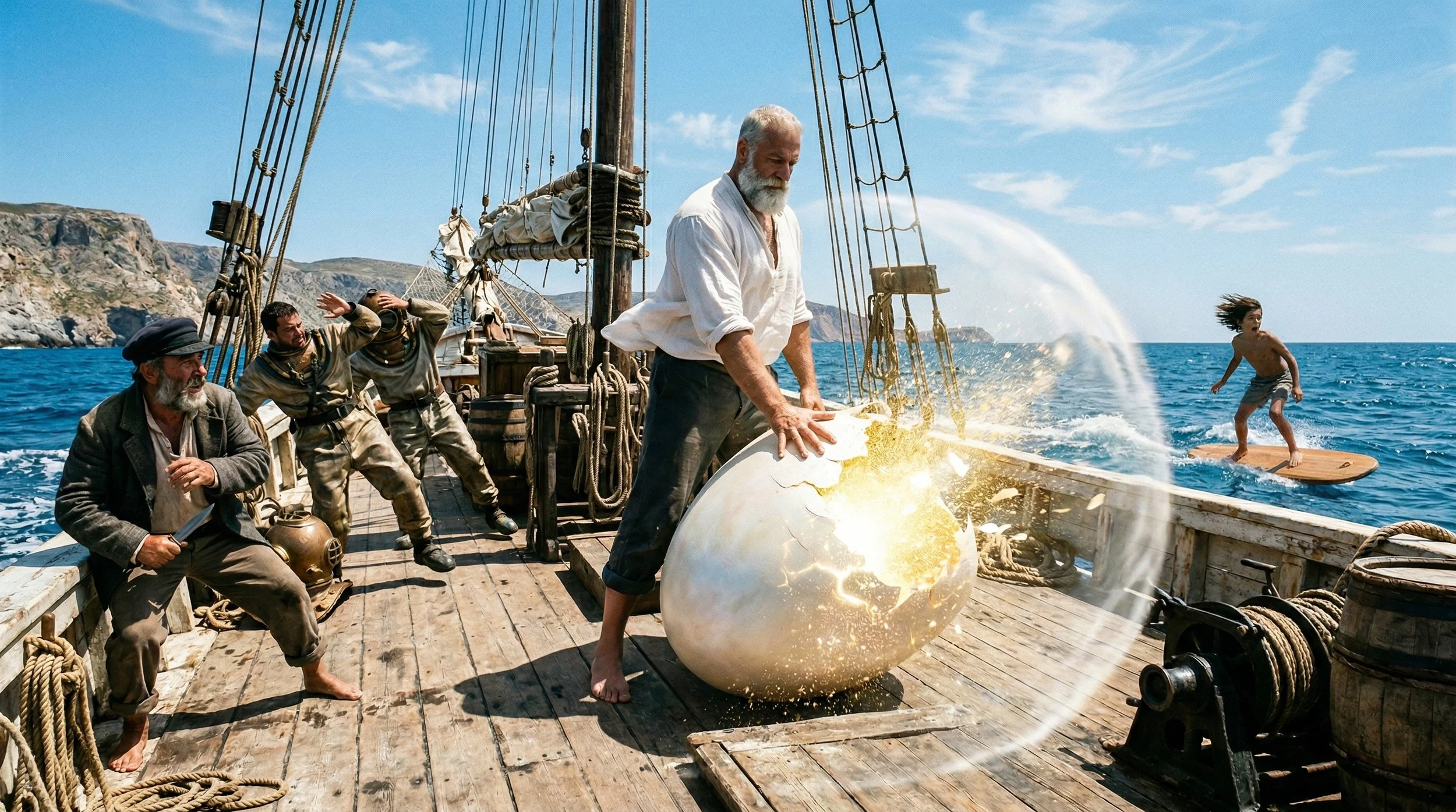
The entire crew traced the voice to find a man taking big, delicious bites off a ruby-red apple. He stood over 200 cm tall, had olive skin, an athletic build, a full, white, well-groomed beard, but hardly any wrinkles on his face. He was barefoot and wore a loosely buttoned linen shirt and pants, with folded sleeves just below his elbows. With all the diving and boating equipment around, this mysterious man looked completely dry.
“Malaka!” Captain Kontos barked. “Who the hell are you?”
His hand was already on the hilt of his knife, instinctively stepping in front of Elias, who looked ready to lunge. Kontos’s voice held a mix of warning, disbelief, and something just shy of fear—though he’d never admit it.
The man took one more bite off the apple and threw the unfinished core into the water, which made almost no splash and no sound into the water. He glanced at the approaching Nikolas— still in a distance— and then said to the cautious crew.
“I am going to give you something.”
Still chewing, he strolled through them as if they weren’t there and laid his palm on the pulsing egg. In an instant, their prize vanished—disintegrating into thin air, followed by a ripple of wind that swept outward in a gentle shockwave. The crew staggered, blinking in surprise. Nikolas, still paddling, felt the wind brush past but mistook it for a shift in the breeze.
“Yeah, yeah, yeah, I know, gets you every time.” Said the man as he pointed to the deck where the egg used to be. “Call it whatever you want, that’s not the point.” The group followed his finger and saw a flat slate in the colour of golden brown— no larger than a fisherman’s tackle box—that had several engravings all around the surface.
But what truly caught their eyes was what lay at its centre.
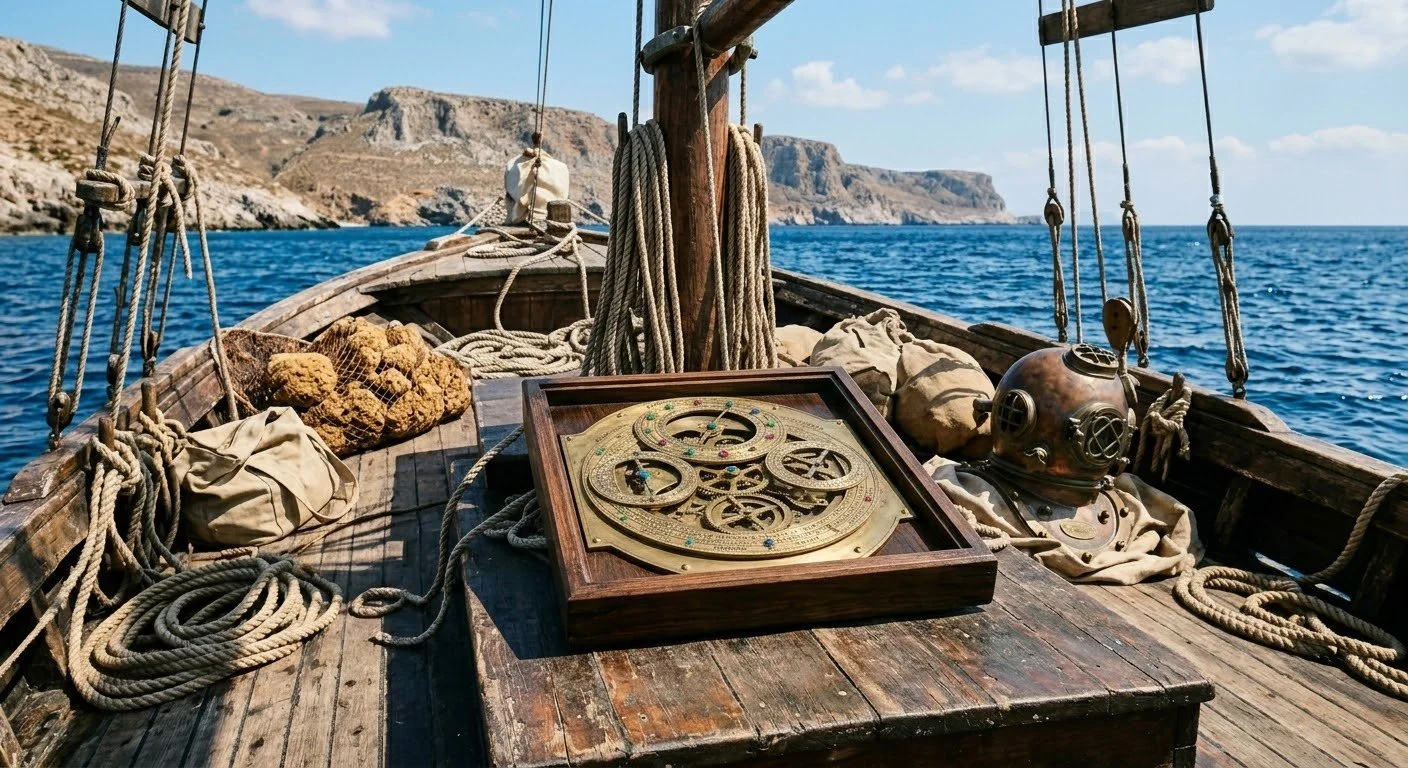
A large clock-like mechanism, its concentric gears and dials meshed together in a delicate, unfathomable order. Several clock hands of varying lengths extended from its core, their metallic arms frozen in place. Scattered among them, tiny gems of different colours gleamed in the dim light, embedded into the structure like celestial markers in an unknown constellation.
With extreme caution, no one in the crew wanted to pick up the object.