
Chapter 02 - Fading Echo
“Strange is the force of memory; it makes the absent present, and the present, absent”
— Euripides (fragment)
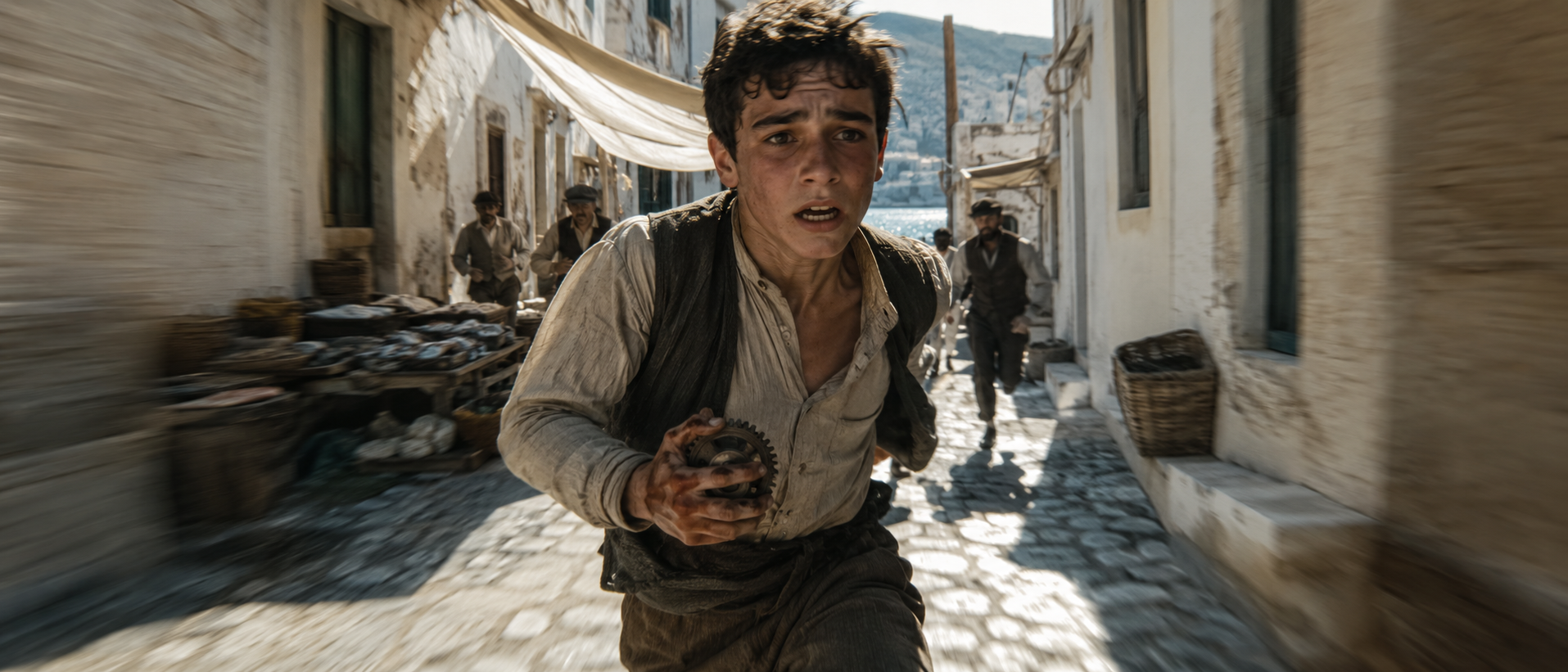
Nikolas ran.
The narrow streets twisted around him, a maze of whitewashed walls and sun-scorched stone. His breath came in ragged bursts, the air dry and sharp in his throat.
He didn’t run because he could—he ran because it was the only thing left. The only thought in his head.
His legs weren’t his anymore—just numb machinery pounding the uneven cobblestones, scraping red against the stone. He barely felt them. Every step jolted up his spine, but his body had taken over, dragging him forward while his mind floated somewhere behind.
There was no strength left, only the momentum of fear. He wasn’t in control—he was inside himself, watching the world blur and tilt as his limbs moved without permission. Hollow. Exhausted.
The scent of sea salt and sweat mixed with sun-warmed rot from the market stalls. Shuttered windows flashed past, faceless and watching. He didn’t know where he was going.
Only that he couldn’t stop.
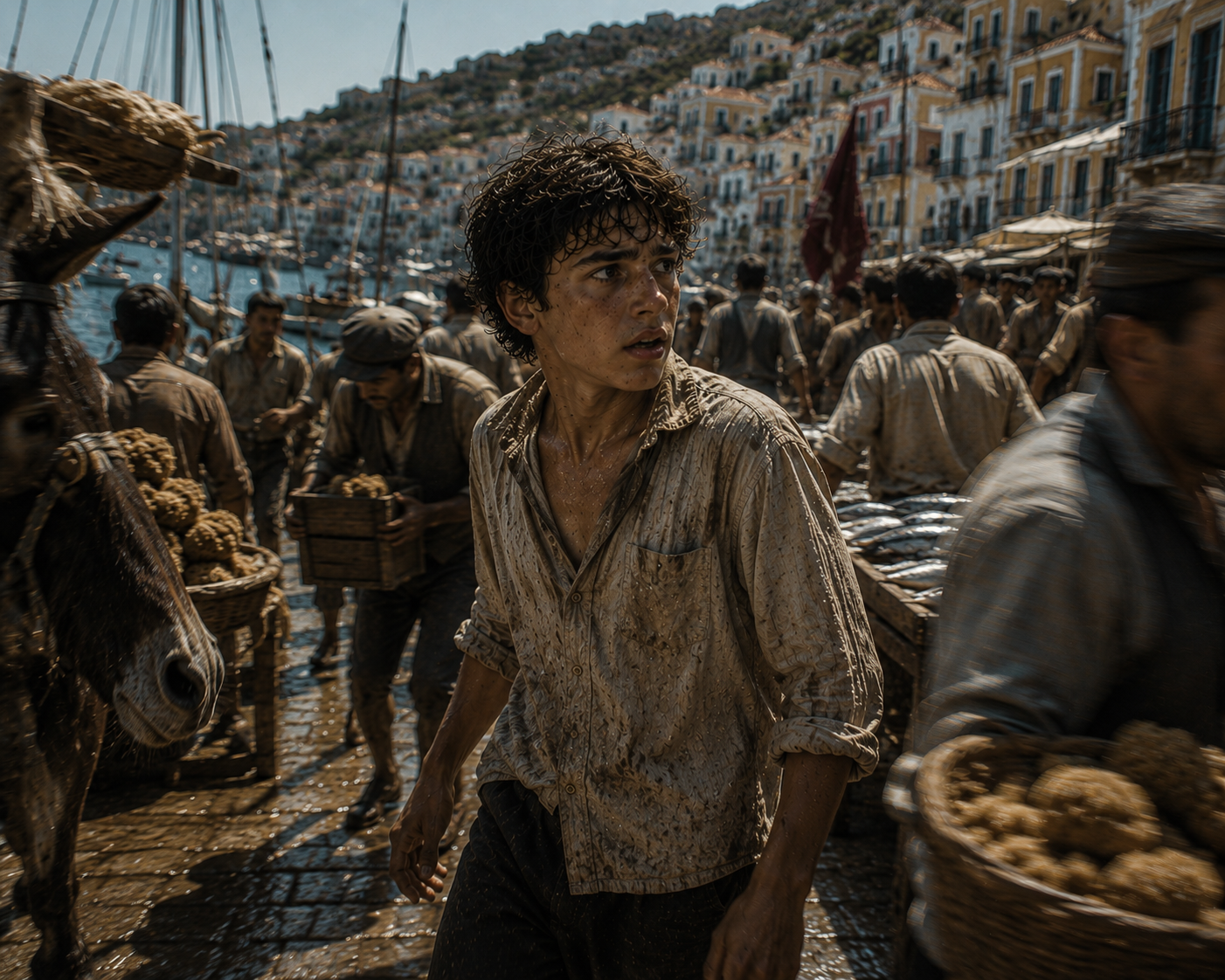
The sounds of the marketplace felt too loud—vendors shouting in rapid-fire Greek, the clatter of carts, the distant bray of donkeys. The air was thick with the scent of roasting meat and fresh herbs, mingling with the tang of unwashed bodies and the sour stench of fish laid out on wooden stalls. Dust swirled up with every hurried step, coating his tongue with the taste of sunbaked stone and smoke.
Donkey carts trundled over the uneven paths, their wooden wheels creaking beneath the weight of sacks filled with olives, figs, and fish packed into woven baskets.
Vendors called out their wares in rhythmic chants, their voices cutting through the hum of conversation. A fruit seller sliced open a pomegranate, its ruby-red seeds spilling across a weathered wooden stall as an old woman haggled without looking up. A boy weaved between carts with a tray of koulouri balanced on his head, moving like he’d been born to the motion. Nearby, a spice merchant scooped handfuls of saffron into parchment pouches—the red threads glinting like slivers of flame in the morning light.
Fishermen, tunics rolled to their elbows, shouted orders as they hauled the morning’s catch from wooden boats bobbing at the quay. Their voices cracked like gulls against the walls.
Another donkey cart passed, harness bells jangling softly. Its wheels creaked under heavy sacks. The donkey brayed, sudden and loud, startling a pair of gulls into flight. Its handler muttered under his breath, steering it past crates of sponges and barrels crusted with salt and fish scales.
Nearby, the rhythmic thud of a hammer echoed from a boat repair shop, where shipwrights worked beneath canvas awnings. They moved with familiarity from repetition, calloused hands steady as they restored fishing boats and sponge-diving vessels—each blow a language spoken in wood and salt and time.
Stone gutters lined the edges of the streets, choked with fruit peels and wilted leaves from the morning’s rush. Overhead, wrought-iron oil lamps hung from stone walls, their soot-smudged glass catching slivers of early light. Along the harbour, wooden posts held gas lamps—unlit now, but still reeking faintly of burned fuel. In shop windows, candle flames flickered behind thick glass, their glow barely reaching the worn wooden counters within.
The air was heavy with the scent of brine and tar, laced with the sharp tang of salt-dried fish and the earthy perfume of freshly unloaded citrus from distant ports.
Every sound every smell, every sight cut through him, too sharp, too immediate. The world around him blurred, colours melting together as his vision tunnelled forward. Shadows stretched unnaturally under the morning sun, flickering between stall awnings, making the shapes around him feel stretched and unreal. The uneven stones beneath his feet jarred his bones, their cracks eating into his bare feet, threatening to cut him with each desperate step.
But the blood—that wouldn’t blur. It clung to his thoughts, a crimson stain in his mind’s eye:
A wet, gurgling sound. Bodies collapsing to the deck, lifeless before they hit the wood. The smell of iron and salt mixed with the briny sea air. A scream cut short.
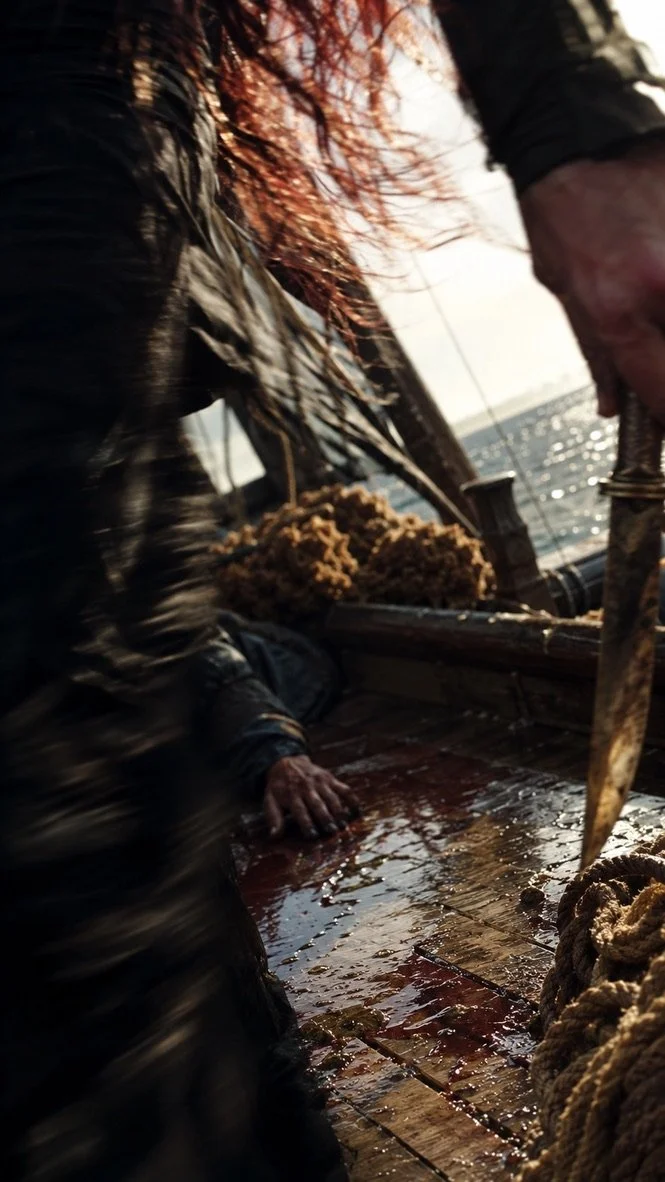
Elias' voice rose above the chaos—frantic, raw with desperation. "Nikolas! Stay away!" His words carried over the crashing waves, cutting through the madness like a blade of its own. It was the only sound that felt real, the only tether to something familiar amidst the nightmare.
The shadow moved through the carnage—fluid, effortless. A blade glinted, cutting through flesh with measured precision. Black cloth rippled, maroon strands flashing like streaks of blood. There was no face, only inevitability—each strike clean, unstoppable. The smell of blood followed like perfume.
A voice—calm, deliberate—cut through the chaos. "I am going to give you something."
Nikolas squeezed his eyes shut.
No. Don’t slow down. Just move.
He barely dodged a wooden cart piled high with figs, stumbling as a vendor shouted after him. A hand grabbed his arm—sharp words, a basket of oranges spilled—but he tore free. Fingernails raked his skin, shallow scratches blooming across his forearm. He didn’t feel them. Didn’t hear the voice.
His chest heaved, vision swimming as he braced against the nearest wall—stone cool and rough beneath his palm, though he hadn’t meant to stop. He’d simply ended up there.
The scents of the market slammed into him—roasted chestnuts, brined olives, charred lamb—all crashing against the metallic tang still burning in his nose.
His collar clung damp to his neck, the scratch of wool biting at his skin, maddening in its persistence.
His hands curled into fists at his sides.
His pulse thundered in his ears.
You have to think. You have to focus.
But thinking meant remembering.
And remembering meant facing what he had just seen.
His fingers twitched—there was something in his grip.
For the first time, Nikolas looked down.
A hunk of metal rested in his hands.
Jagged edges, fine teeth. Traces of shell growth, crusted over with centuries of moss and grit. It looked… old. Far too old.
The weight of it dragged at his arm, the metal biting into his fingers and wrist. His grip had been too tight, his muscles too rigid—his body unwilling to let go even as his mind remained dazed, unable to grasp the why.
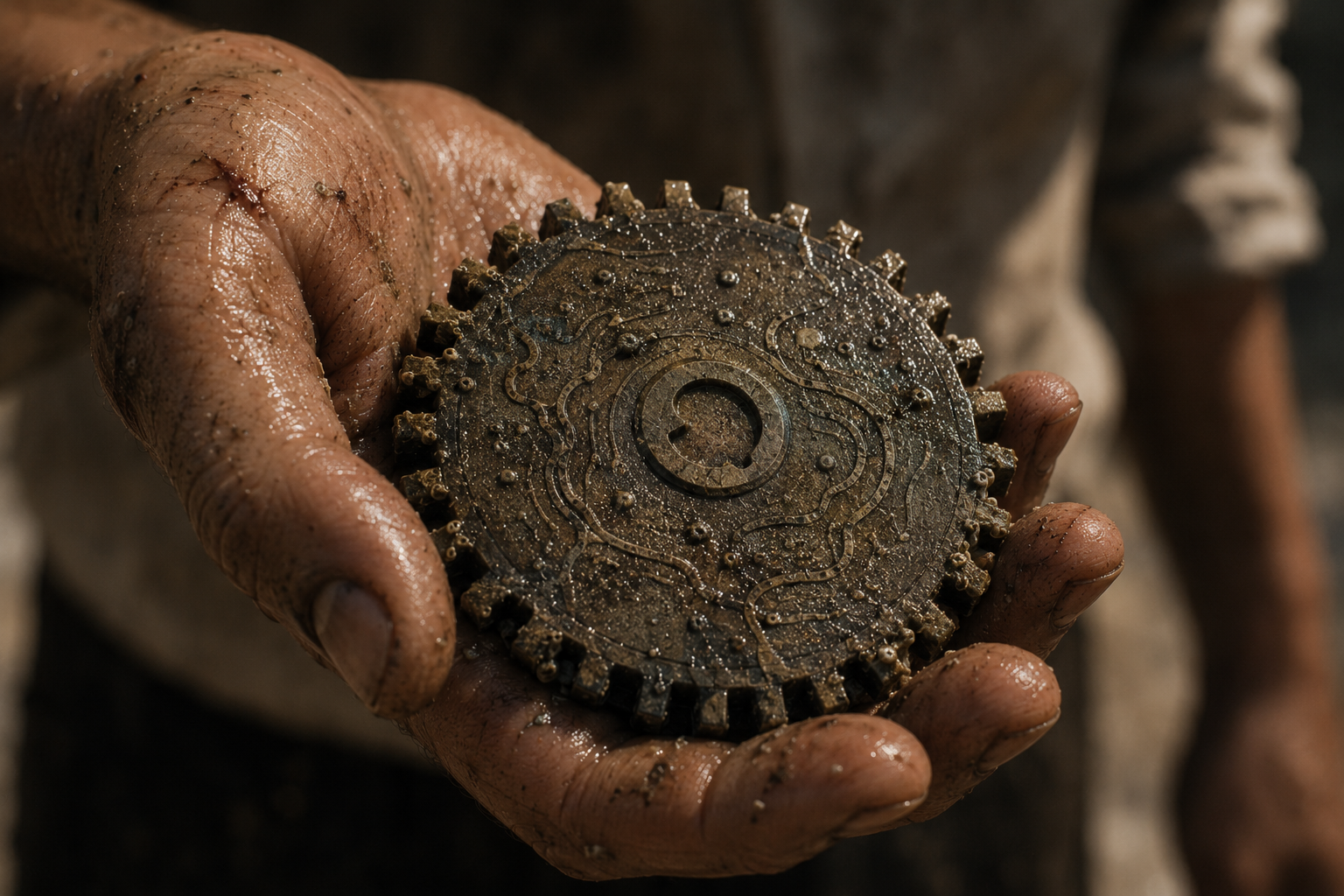
As he loosened his hold, a sharp ache flared up his forearm. The pressure points throbbed, skin marked where the uneven edges had pressed too deep. Tiny punctures. Streaks of red. A rough imprint pulsing in time with his pounding heart.
Why am I holding this?
A fresh wave of nausea rolled through him. He had no memory of grabbing it. No recollection of how it had ended up in his hands. He does know, somehow, that this is way more important than it looked.
He inhaled sharply, his mind clawing for answers—but there were none. Only the overwhelming sense that something was wrong.
I want to go home!
That thought struck suddenly, cutting through the panic like a blade. Home. His family. They would help him make sense of this.
He pushed forward, forcing his feet to move, weaving through the sea of bodies. The streets twisted before him, but he barely paid attention—his body moved on instinct, following paths he had walked daily.
And yet—something was off.
Am I in Symi?
The streets felt different. The turns, the spacing between buildings—something in his memory didn't align. A corner he thought should have led to a familiar tavern led elsewhere, the layout just slightly askew. A shop he swore had been an apothecary was now a bakery. A bridge he didn’t recall ever crossing seemed to stretch longer than it should have.
Nikolas blinked, sweat dripping into his eyes. His stomach knotted.
Disoriented. Shocked. Fractured.
The further he walked, the more the unease burrowed into his bones.
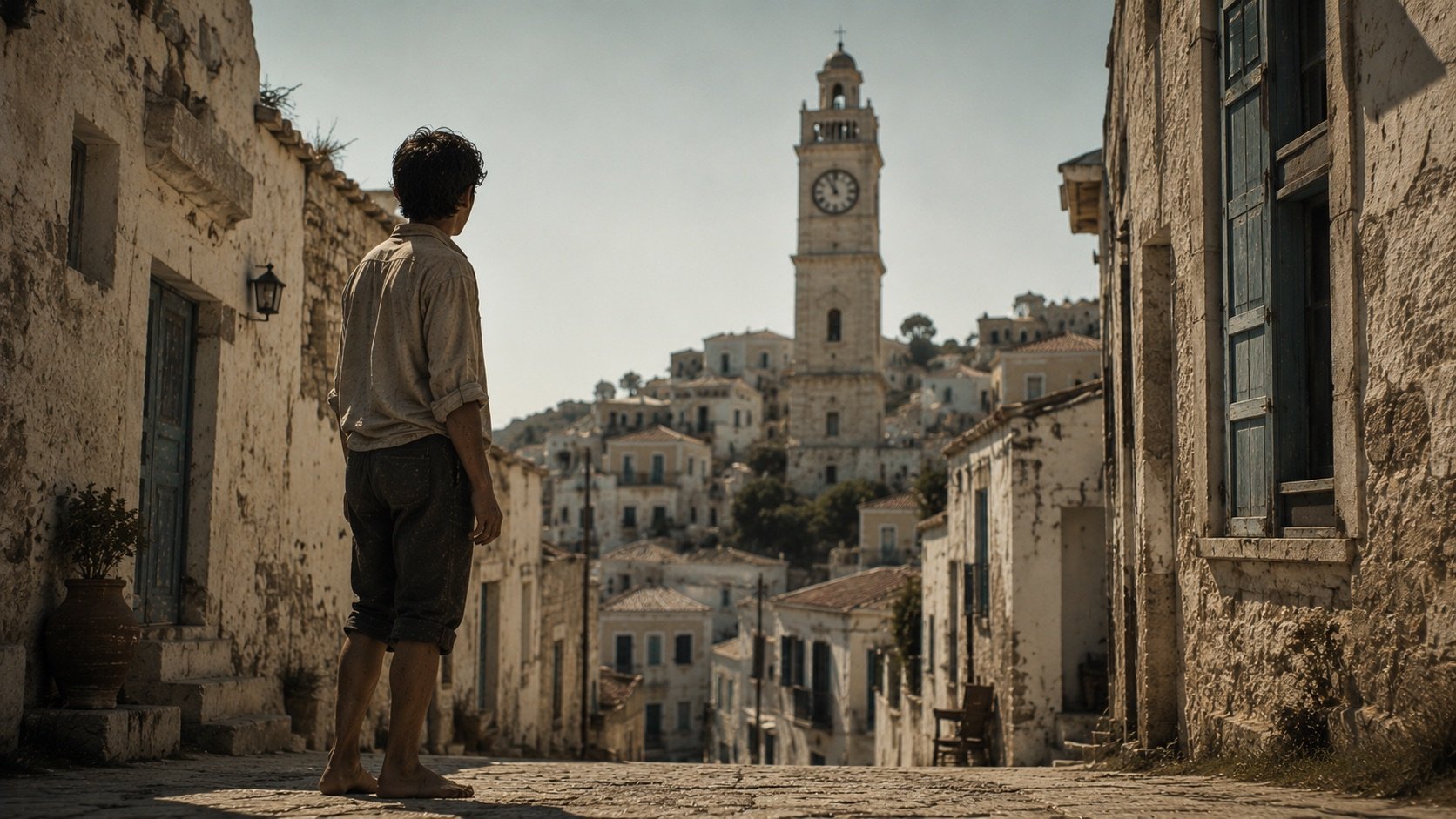
He turned another corner, searching for a familiar street, building, something. Then he noticed it
The town clock tower.
Nikolas' gaze lifted, landing on the town clock tower in the distance. It should have been reassuring—a fixed point in his memory, an anchor in the familiar streets of home. But something was wrong. The face of the clock seemed subtly different, the hands not quite where he expected them to be. The stone looked newer, too smooth against the wear of time. Had it always looked like this? He hesitated, the gnawing unease tightening around his ribs, before forcing himself to move on. He had walked this street a thousand times, yet for a second, it felt as foreign as a city he had never stepped foot in.
Ahead, a familiar path tugged at the edges of his memory. He recognized it—but something was wrong. The buildings stood as he remembered, yet small, imperceptible changes nagged at him—stone that looked too fresh, doorways slightly narrower than they should have been. The stones beneath his feet, once worn smooth from years of foot traffic, seemed rougher—uneven in a way they hadn’t been before. Newspaper stalls stood at the intersections, stacked with freshly inked broadsheets, headlines in bold Greek script announcing political debates and foreign affairs. The familiar scent of fresh bread drifted from a kafeneio nearby, where men in fustanella and tailored suits gathered for their morning coffee. His family’s home wasn’t far.
Nikolas moved faster, heart pounding, breath shallow. As he turned the final corner, he expected relief to wash over him.
Instead, he froze.
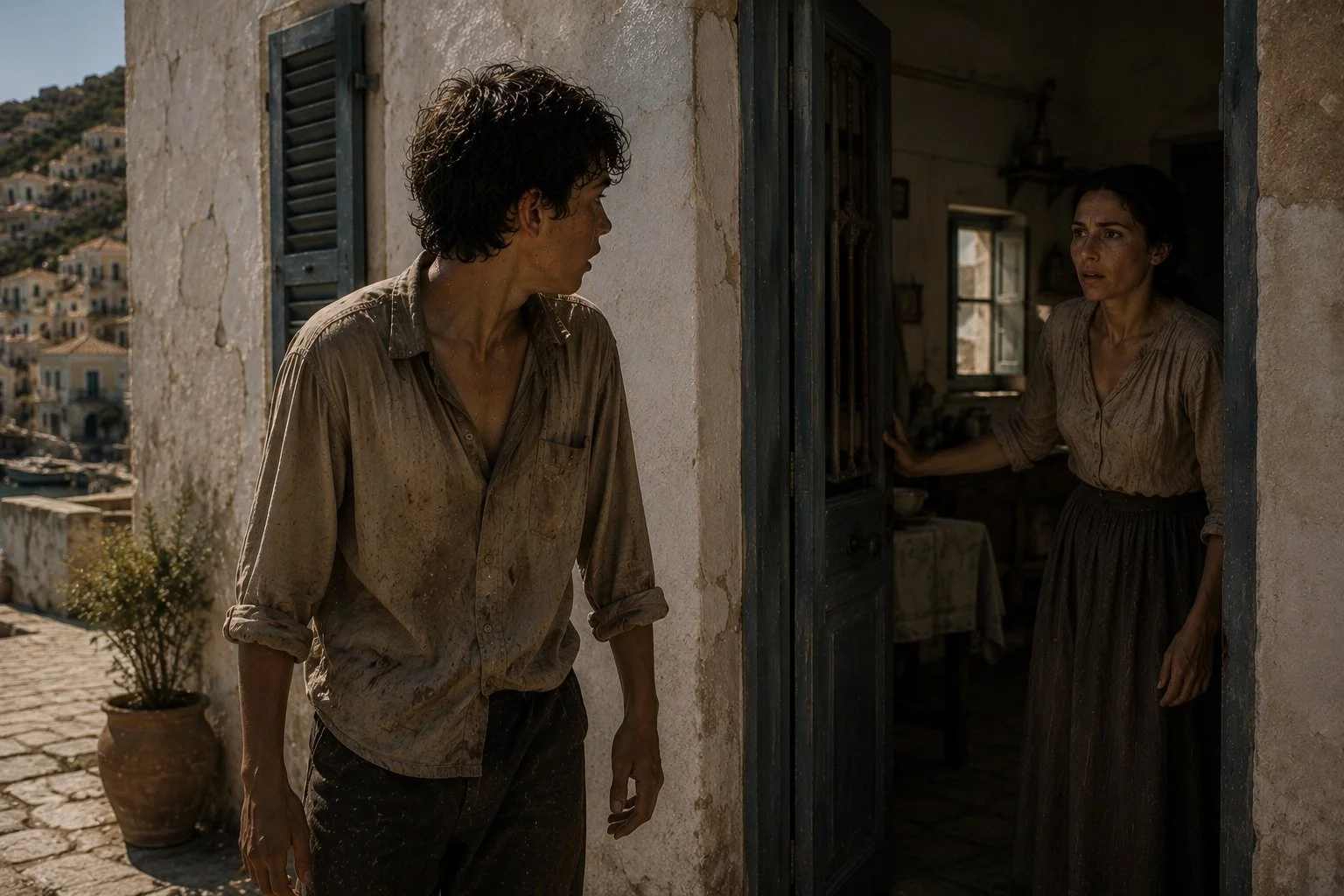
The house was there. Or at least, it should have been. But the whitewashed walls looked too clean, the shutters too new, as if the building had been repainted in his absence.
The shutters were painted a different colour. The stone pathway leading to the door was missing the crack he had memorized as a child. A clay pot, the one his mother had always kept by the steps, was gone.
Nikolas’ breathing grew shallow. His home was here—but it wasn’t his.
Before he could knock, the door swung open.
A woman stood there, her expression shifting from surprise to warmth.
“Nikolas,” she breathed, reaching for him. “You didn’t ship out today?”
He flinched, stepping back. The way she said his name—so familiar, so certain—sent a cold prickle down his spine. He didn’t know her.
Her brow furrowed. “Nikolas? What’s wrong?”
His chest tightened. He didn’t recognize her. But she recognized him.
A child’s laughter echoed from inside. A voice he didn’t recognize.
The wrongness pressed down on him, suffocating.
He turned and walked away.
Faster.
Then he ran.